
Contents

Demographics
Group Names
Use of Group Names
On this web site, we will use the following system:
• Iranian Zoroastrians are Zoroastrians in Iran and with origins in Iran (Persia), and
• Indian Zoroastrians are Zoroastrians in India who migrated from Iran to India.
Amongst the Zoroastrians who made India their home are:
• Parsis or Parsees (meaning Persians) are Zoroastrians who came with the first migration wave to India 1,300 to 1,000 years ago, and
• Iranis or Irani Zoroastrians are Zoroastrians who migrated to India in the last three hundred or so years, in large part from the Iranian provinces of Yazd and Kerman. In population statistics, Irani Zoroastrians are frequently counted as Parsees. (Note the difference between Irani Zoroastrians here and Iranian Zoroastrians above.) Also see Irani Zoroastrians of India.
Migrations & Diaspora
Zoroastrians have been on the move from their original Central Asia homeland for thousands of years. Three thousand years ago the history became aware of the Persians and Media in the north-western corner of present day Iran. In the period from 800 - 700 BCE, the Persians migrated south and east into the area surrounding modern-day Pars (Fars) province in Iran.
For a thousand years from 700 BCE to 640 CE, the Persian empire became the home of Zoroastrianism. Zoroastrians did not actively proselytize or engage in the forcible conversion of peoples of other religions. The Persians and Persian monarchs were for the main part accepting of other religious traditions co-existing throughout the empire. As such, Zoroastrianism did not spread in the manner of other world religions - it remained primarily a religion of people of Aryan or Iranian descent. This does not mean there was any attempt at exclusivity and it is widely reported that there were pockets of local Chinese and other ethnic groups throughout areas of Aryan influence and trade who were Zoroastrians. There is a possibility that Zoroastrian migrants also intermarried with locals to some extent and that these intermarried spouses and their children became part of the Zoroastrian family. The Zoroastrian population at the height of the Persian empire and during the Sassanian era in Iran (220-650 CE) must have numbered in the millions. For a few centuries after the Arab defeat the Sassanian king of Iran, the Zoroastrians of Iran were still substantial in number. In a presentation to the North American Zoroastrian Congress in 1996, Dr. Daryoush Jahanian cites Jean Chardin, a French traveller who visited Iran in medieval times who wrote that 40% of Iranians were Zoroastrians. That would put the number of Iranian Zoroastrians during the fifteenth century CE as between three and five million. Short of active proselytization, through what process Zoroastrians grew to a population numbered in the millions is not known.
In the centuries after the Arab invasion around 640 CE, a small groups of Zoroastrians migrated from Iran to India. The Zoroastrians who remained in Iran lived mainly in the provinces of Yazd and Kerman.
According to tradition, one of the conditions for permitting the Zoroastrian refugees to settle in India, was that they would not convert Hindus to Zoroastrianism. For the Zoroastrians who remained in Iran, any attempt at converting a Muslim would have resulted in certain death. These conditions combined with the emancipation of Zoroastrians, marriages late in life and fewer births than deaths, resulted in a declining population that reached levels of around 130,000 people worldwide in the 1960s. This number makes Zoroastrians one of the smallest religious minorities in the world.
In the late 1700s, the Zoroastrian migrants to India, the Parsis, started to re-establish their historic trade links with China and in doing so set up a settlement in China. In the 1830s and 1840s, Parsis expanded their trade links to colonies in the British empire including Aden, East Africa, and Britain. After 1870, the Parsis settled in significant numbers in East Africa, especially Nairobi and Mombasa. With the relaxation of immigration rules to Britain, Canada, the United States, Australia and New Zealand in the 1960s, Zoroastrians from India, the former British colonies and Iran, began to migrate once again - this time to the New World, if we may be permitted to use this name for lands that were home to their Aboriginal peoples.
The major Zoroastrian population centres in the world today are Mumbai and Pune in India; Los Angeles, US; Toronto, Canada, and London, England.
Danger of Extinction

|
| Parsi population decline (India) |
The following points illustrate the dangers faced by Zoroastrianism:
• Guinness Book of World Records lists Zoroastrianism the "major religion nearest extinction."
• Youth under 18 years of age account for 18% of the Zoroastrian population.
• Adults over 60 years of age constitute 31% of the Zoroastrian population, the highest for an ethnic group anywhere in the world.
• By 2008, the birth-to-death ratio was 1:5 - 200 births per year to 1,000 deaths (The Guardian 2008-06-28).
• The literacy rate amongst Zoroastrians is the highest in India (or anywhere in the world) at 97.9%.
• Despite the above, statistics to the contrary are beginning to emerge. For instance, The World Almanac And Book Of facts distributed by St Martin's Press and printed in the US, lists the current Zoroastrian population world wide is 2,728,000.
Worldwide Population Figures
All rounded figures are approximate.
| Country or Region | 1855 1 | 1941 | 1976 2 | 19903 | 2004-5 | 20064 |
|---|---|---|---|---|---|---|
| India | 145,544 | 114,000 | 77,000 | 69,600 | 69,000 | |
| Iran | 7,158+ | 20,000 | 25,000 | 24,000 | 20,000 | |
| Pakistan | 5,000 | 2,800 | 2,100 | 1,800 | ||
| Singapore | 4,500 | |||||
| Hong Kong | 150 | 200 | ||||
| Kenya & Africa | 80 | ? 100 | ||||
| Afghanistan | 10,000 | |||||
| Azerbaijan | 2,000 | |||||
| Persian Gulf | 2,200 | |||||
| USA | 6,500 | 10,800 | 11,000 | |||
| Canada | 4,500 | 5,300 | 6,000 | |||
| Britain | 2,000 | 5,000 | 5,000 | 6,500 | ||
| Australia | 75 | 300 | 2,500 | 2,700 | ||
| New Zealand | 45 | 840 | 1,000 | |||
| Total | 152,694+ | 134,000+ | 131,000+ | 127,000+ | 137,000 | |
| Notes: 1. Maneckji Limji Hataria 2. The Eliade Guide to World Religions 1991 3. Coward, Hinnells, Williams and other sources 4. Laurie Goodstein at New York Times and other sources. | ||||||
Iranian Zoroastrian Demographics
About a hundred years ago, Zoroastrians from Yazd constituted the largest number of Iranian Zoroastrians. Today, most of Iran's Zoroastrian population is concentrated in the capital, Tehran.
| City | 1855 1 | 1903 2 | 1917 3 | 1966 4 & 5 | 1971 6 | 1975 7 | 1986 8 |
|---|---|---|---|---|---|---|---|
| Yazd & vicinity | 6,658 | 8,000 - 8,500 | 10,000 | ? | 5,000 | 4,000 | 4,685 |
| Kerman | 450 | 2,400 | 2,800 | ? | 2,000 | 3,882 | |
| Tehran | 50 | 324 | 200 | 9,000 | 10,000 | 19,000 | 24,240 |
| Kashan | 45 | ||||||
| Shiraz | "handful" | 42 | |||||
| Isfahan, Qom | 18 | 5,794 | |||||
| Mazandaran | 1,417 | ||||||
| Gilan | 5,008 | ||||||
| Khorasan | 10,575 | ||||||
| Kurdistan | 1,007 | ||||||
| Total | 7,158+ | 11,000 | 13,000 | 20,000 | 25,000 | 90,891* | |
|
Notes: 1. Maneckji Limji Hataria 2. A. V. Williams Jackson 3. D. L. Lorimer 4. Eckehard Kulke 5. 1966 Iranian Census 6. Michael Fischer 7. G. Windfuhr 8. 1986 Iranian Census * Some (cf. Mobed Firouzgary) have suggested that this dramatic increase in the number of Iranian Zoroastrians is due to Baha'is listing themselves as Zoroastrians since their religion is banned in Islamic Iran. | |||||||
While by 1975, Tehran had become the centre of Iranian Zoroastrians in the last hundred years, the Zoroastrians of Tehran had for the main part migrated there from Yazd, Kerman and the other districts. Due to migrations to North America, by the mid 1980s, the number of Zoroastrians in Iran had declined to 20,000 with few Zoroastrians left in Kerman.
According to the Iranian census. in 1956 the percentage of Zoroastrians living in villages was 42 percent, while in 1986, that figure had fallen to 15 percent.
Michael Fischer reports that in 1971, the population of the orthodox Zoroastrian village of Sharifabad in Yazd was quickly declining. Later reports state that since the village was entirely abandoned with most of its inhabitants having moved to Tehran. Other villages, such as Astarabad (Gorgan) and Sadrabad, have also been vacated. However, we have seen recent reports concerning the Yazd pilgrimage sites which indicate that many of the Yazdi villages have a small but aging Zoroastrian population.
The migration from villages to Tehran is also causing a profound change in the way Iranian Zoroastrian understand and practice Zoroastrianism. Sharifabad and other Yazdi villages were the seat of Zoroastrian orthodoxy. Even the Parsees of India sent delegations or representatives to Yazd with questions on Zoroastrian practice and customs. They even faithfully followed the Qadimi calendar. The Tehrani Zoroastrians have a tendency to an ultra modern interpretation of Zoroastrianism.
Indian Zoroastrian Demographics

Alternative figures that we have found are for 1901: 94,359, 1911: 1,00,096, 1921: 1,01,778. See below.
Shahenshahi (Shenshai) / Qadimi (Kadmi) Figures
| 1872 | Shahenshahi | Qadimi |
|---|---|---|
| Bombay | 40,809 | 3,282 |
| Rest of Bombay Presidency | 29,838 | 1,770 |
| Total | 70,647 | 5,052 |
| 1881 | Shahenshahi | Qadimi |
|---|---|---|
| Bombay | 43,292 | 5,305 |
| Rest of Bombay Presidency | 24,001 | 548 |
| Total | 67,293 | 5,853 |
| 1911 | Shahenshahi | Qadimi |
|---|---|---|
| Baroda State | 7,778 | 177 |
India's Zoroastrian Population - 1911 Census
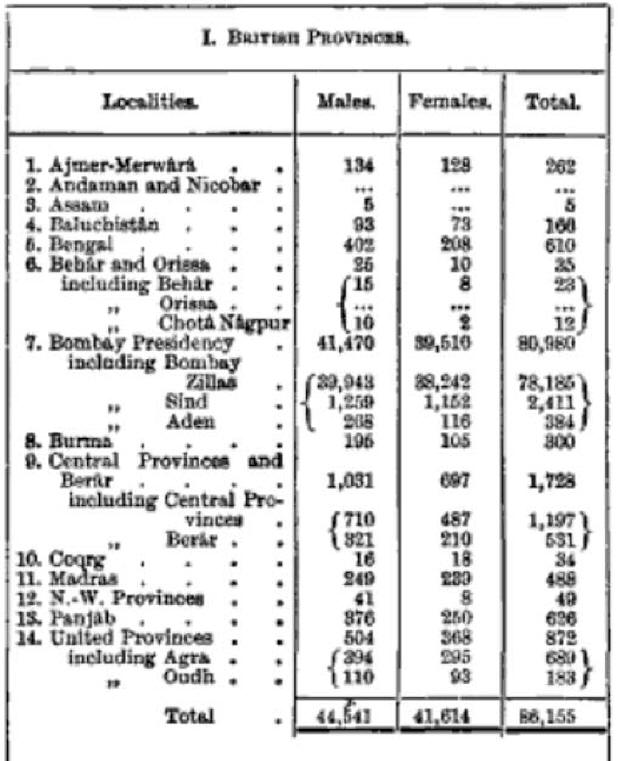 |
| 1911 Census of Zoroastrians in India Part I |
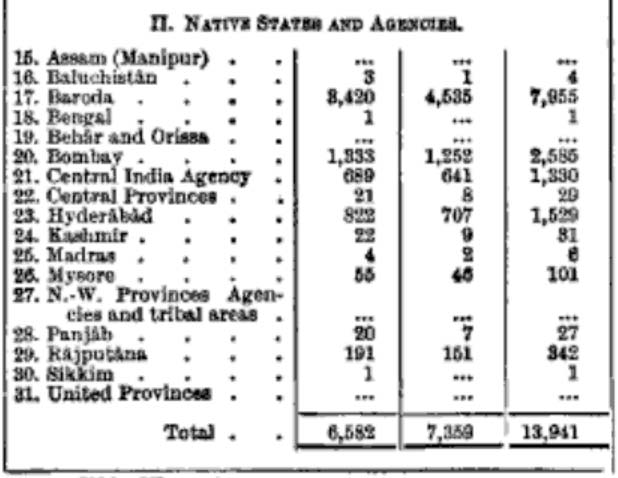 |
| 1911 Census of Zoroastrians in India Part II |
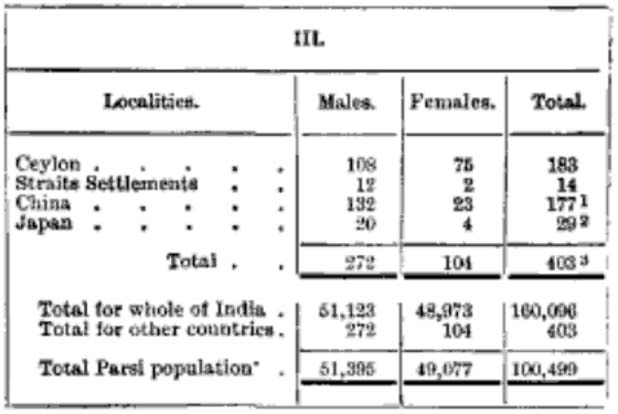 |
| 1911 Census of Zoroastrians in India Part III Credit: Encyclopedia of Religion and Ethics, Part 18 by James Hastings |
| 1911 Major Cities Population | |||
|---|---|---|---|
| City | Male | Female | Total |
| Bombay | 26,764 | 24,267 | 50,931 |
| Surat | 2,404 | 3,054 | 5,458 |
| Baroda State | 3,420 | 4,535 | 7,955 |
| Nausari | 1,630 | 2,591 | 4,221 |
India's Zoroastrian Population - 1921 Census
|
Comments by L. J. Sedgwick, Bombay's Census superintendent: "The case of Zoroastrians is most noticeable. The survival value of the Parsees is very high. It was found when studying the Bombay city population that whereas in the city population as a whole the Zoroastrian percentage is 4.4, in the age groups 55 and over it is 8.8 and in the age groups 65 and over it is 17. The Parsee community has been gradually changing in age distribution during several decades.
|
But though the survival value is high and though number of Zoroastrians increased at this census, yet the value of the lowest age groups distinctly suggests a danger ahead. The age distribution for all European countries is given at pg 63 of the report of the 1911 census of England and Wales. From the figures there given it will be seen that the Parsee age distribution (even assuming that the deficiency in group 0-5 is temporary only) is more unfavourable in the lower age groups than that of any European country except France. So long as the community holds its own as it did at this census it is all right. But the point of equilibrium might be passed some day, and the community may begin to diminish in numbers."
In 1921, despite the longevity of Parsees (this designation probably includes all Zoroastrians, both Parsees and Iranis), Sedgwick raised the alarm about "the value of the lowest age groups distinctly suggests a danger ahead."
Source: Parsee Prakash Vol. VI - Part I as quoted in parsis.net.in
Indian Zoroastrian Marriage Rate 1921
The Census Commissioner for India, J. P. Marten commented on the 1921 census that, "The census also indicates that fewer Parsees per cent are married than members of other communities. Whereas 61% of Hindus and 56% Mahomedans are married only 40% Parsees are married, while the proportion of widows 8% is greater than all other communities."
Source: Parsee Prakash Vol. VI - Part I as quoted in parsis.net.in
| ||||||||||||||||||||||||||||||||||||||
Indian Zoroastrian Longevity Rates 1921
Regarding the longevity of Parsees i.e. Zoroastrians: while the percentage of Parsees in the total population was 4.5 percent, in the age group of 55 and over it rises to 8.8 percent, and in age groups 65 and over it rises still further to 17 percent. In other words, while in 1921, one in every 22 or 23 persons in Bombay was a Parsi, in the age group of persons over 65 years of age, one in every six individuals was a Parsi i.e. Zoroastrian.
Indian Zoroastrian Mortality Rates
The mortality rate in India for Parsi (probably including Irani) Zoroastrians as reported in the 2001 census conducted by the Government of India shows that approximately 90 percent of mortality occurs at age 61 and above - a significant difference from the rest of the Indian population.
Indian Zoroastrian Literacy Rates
The literacy rate of Indian Zoroastrians in 2001 was 97.9%, the highest for any Indian community (the national average was 64.8%). In 2001, 96.1% of Parsees (probably including Iranis) resided in urban areas while the national average is 27.8%.
Zoroastrian literary rates, including university education rates are amongst the highest of any ethnic group in India or foe that matter anywhere in the world.
Indian and Iranian Zoroastrian literacy rates grew substantially in the 1800s. Sir Jamshedji Jeejeebhoy played a significant role in the growth of Indian-Zoroastrian Literacy, while Maneckji Limji Hataria played a similar role in Iran.
The first Indian schools for Zoroastrian children were built by the Parsi Benevolent Fund established with a Rs. 300,000 donation by Sir Jamshedji Jeejeebhoy in 1849. Jamshedji Jeejeebhoy was reportedly very concerned about 'the hopeless ignorance' in which Zoroastrian children were growing up.
In 1901, the number of literate (the ability to read and write in any language) Indian Zoroastrians in the Bombay Presidency including the native states was stated as 51,000 out of 78,552 (65%). The 65% literacy rate of the Zoroastrian population
compares with 29% for Christians, 27% for Jains, 6% for Hindus and 4% for Muslims. It is interesting to note that out of 4,946 literate Zoroastrian-Parsees in Baroda, 2367 were male while 2579 were female - a slightly greater number for female Zoroastrians. In no other religious group was the percentage literate women so high. Indeed, despite Zoroastrians being a very small minority of the total population in Baroda, Zoroastrian women constituted about 33% of the total population of literate women in Baroda.
Of the 51,000 literate Zoroastrians noted above, 20,252 were literate in English - that is, approximately 40% of literate Zoroastrians were literate in English in the Bombay Presidency. Amongst the various groups in the Bombay Presidency, of those literate in English, 26% were Zoroastrians, 1% were Jains, 0.4% were Hindus and 0.2% were Muslims. We are not told who made up the balance of the population literate in English.
In 1911, literacy rate for Indian Zoroastrians in the Bombay Presidency including the native states was stated as 60,005 in 83,565 (72%).Of the 60,005 literate Zoroastrians noted above, 20,252 were literate in English (40%)
In 1901-1911, the Parsees were responsible for making Gujarati the principle Indian language of commerce in Bombay. The Gujarati local press was mostly in the hands of Parsees. Furdunji Murzbanji started the first native language newspaper in Bombay.
Mumbai (Bombay), India, Zoroastrian Population Figures
Mumbai (Bombay) Zoroastrian Population 1851
| ||||||||||||||||||||||||
| 1851 Mumbai Zian Pop. | |
|---|---|
| Male | 68,754 |
| Female | 41,790 |
| Total | 110,544 |
We have a set of figures for the population of Bombay according to the August 20, 1851 census which show the Parsi population of Bombay at 110,544 and as quoted by Dosabhoy Framjee in Parsees, Their History, Manners, Customs, and Religion.
These figures seem at variance with the figures in the graph above and were questioned as being too high by the Parsees of that time. Other than an error, one explanation could be that between 1851 and 1881, a large number of Parsees moved away from Bombay.
Mumbai (Bombay) Zoroastrian Population Decline 1970-2001
In 1971, approx. 70,000 Zoroastrians lived in Greater Bombay (more than half the worldwide Zoroastrian population). The total Indian population was 91,266.
In 1981, 68,676 Zoroastrians lived in Greater Bombay. The total Indian population was 71,630. (2,954 lived elsewhere in India.)
In 2001, 46,557 Zoroastrians lived in Greater Bombay.
Despite a fast declining population, as a city, Bombay / Mumbai, India, has the largest concentration of Zoroastrians anywhere in the world. These Zoroastrians include Zoroastrians known as Parsees (from Parsi meaning Persian), the earlier Zoroastrian migrants to India, and Iranis, the later Zoroastrian migrants to India.
Zoroastrian Interfaith Marriages in Mumbai (Bombay) 2008-10
Percentage of Zoroastrian Interfaith Marriages in Mumbai:
2008 - 44%
2009 - 31%
2010 - 38%
Source: Hindustan Times quoting Parsiana who have gathered records of Parsi marriages from the Bombay high court and the Registrar of Marriages at Bandra and Fort since 1989.
Zoroastrian Non-Marriage in Mumbai (Bombay) Early 2000s
In the Greater Mumbai area approx. 10% of Parsi females and 20% of Parsi males do not marry (Roy & Unisa 2004, pp. 18, 19).
Zoroastrian Demographics Elsewhere in the World
Pakistan's Zoroastrian Population
According to John Hinnells in The Zoroastrian Diaspora, the population of Zoroastrian in Karachi, the principle commercial centre and port of Pakistan, the Zoroastrian population exceeded 2,000 people in 1911. by the time of the first census held by independent Pakistan in 1951, the Zoroastrian Karachi population was 5,018 individuals. That figure dropped to 4,685 by the 1961 census.
According to a 1995 census conducted by the Zarthoshti Banu Mandal in Karachi, the population of Pakistani Zoroastrians had dropped to 2,831. In September 2004, the population had further declined to 2,121. In 2009-2010, Toxy Cowasjee placed the figure at 1,766.
Hong Kong's Zoroastrian Population
According to John Hinnells in The Zoroastrian Diaspora, Hong Kong, had about 120 Zoroastrians in the 1980s. The population may stand at around 200 in 2010.
Britain's Zoroastrian Population
 |
| Tata family mausoleums in the Parsee section of Brookwood Cemetery, Woking, England |
England is considered to be the home of the oldest Zoroastrian community in the West. One indication of the age of the community is the Zoroastrian (Parsi) section of the Brookwood Cemetery established in November 1862. Brookwood Cemetery is about 4 miles west of Woking in Surrey. Zoroastrian / Parsi immigrants to Britain would have long preceded that date. The Tata family have mausoleums in the Parsee section.
The 1980 population of British Zoroastrians was estimated as 2,000 by John Hinnells in Zoroastrians in Britain.
The 2001 British census counted 3,738 Zoroastrians in England and Wales.
The 2004(?) figure was estimated as 5,000 by Rusi Dalal in a FEZANA Winter 2004 article titled Demographics of Great Britain.
2010 estimates indicate that the Zoroastrian population of Britain might have grown to between 6,000 and 7,000.
 |
| Parsee Section of the Brookwood Cemetery Wikimedia |
US Zoroastrian Population
According to Roshan Rivetna in 2004, there were 9,158 enumerated Zoroastrians in the US and accounting for those not part of the enumeration process, an estimated maximum of 10,794 individuals.
Canada's Zoroastrian Population
The Canadian census of 1991 stated 3,185 self-identified Zoroastrians. This figure may not be entirely reliable since the identification required self-notification.
According to Roshan Rivetna in 2004, there were 5,341 Zoroastrians. Together with the US figure, this gives a North American total of about 15,000 to 16,000 Zoroastrians.
Australia's Zoroastrian Population
There are no precise numbers for Zoroastrians in Australia. Estimates can be constructed based on the membership in local Zoroastrian associations.
In the 1970s there were an estimated 75 Zoroastrians in Australia.
By 1999 The number may have increased to about 1000 individuals with about 850 residing in Sydney (Hinnells, The Zoroastrian Diaspora, p. 555, based on the Sydney's Australian Zoroastrian association directory).
In 2004, the Australian Zoroastrian population is estimated to have increased to between 2,000 and 3,500 individuals.
New Zealand's Zoroastrian Population
We found these notes on the web at jamejamshedonline and have included them as they show some interesting trends:
"The first known Zoroastrian to come to New Zealand was Hormuzji Ratanjee Shroff, a businessman with a Master of Arts degree from Oxford University, England. He migrated in 1877 with his wife and three children and set up a hardware supply business, Shroff and Sons, in Auckland which is still being run by his descendants.
"In 1986 there were said to be just about 17 Zoroastrians in the country. By 1990 the number increased to approximately 45 and by February 2000 the community numbered 300.
"The demographics of the Zoroastrian community in New Zealand, as compiled by former ZANZ (Zoroastrian Association of New Zealand) president Tehmus Mistry from 2003 data, sets the total figure at 840 individuals. Adult males number 331, and adult females 302. Comprising 349 families, 75 have one child, 120 have two children and 12 have three and over. About 142 families are unaccounted for in terms of their children and presumably are couples or single member households. The majority - 90 percent - live in Auckland, four percent in Wellington and two percent in Christchurch. The majority of new migrants were originally from Bombay, but the Middle East, Pakistan, Canada and the US have also contributed to the growing community.
"New Zealand now has a Zoroastrian population of over a thousand and still growing."
Contrary Assertions Showing Dramatic Growth
David A. Barrett, editor of the World Christian Encyclopedia, 2001 states that the Zoroastrian population had by 2000 grown to 2,543,950. It is unclear where David Barrett obtained these figures. If true, the figures make Zoroastrianism the world's fastest growing religions on a percentage basis. The reason he gives for this dramatic rise is the number of individuals who declared that they were Zoroastrian in the Aryan home countries - primarily Iran:
| Country | 1970 | 2000 |
|---|---|---|
| Afghanistan | 0 | 304,454 |
| Iran | 22,500 | 1,903,182 |
| Tajikistan | 0 | 7,426* |
| Uzbekistan | 0 | 3,042 |
| Total | 22,500 | 2,218,104 |
Barrett further predicts that the Zoroastrian population in 2025 will be 4,439,930, and in 2050 it will has risen to 6,964,700!
It has been reported anecdotally, that there are a number of closet Zoroastrians in the Aryan home countries (Iran, Afghanistan, Northern Iraq, Tajikistan, Uzbekistan, Turkmenistan and neighbouring lands) who are outwardly Muslim but who are secretly Zoroastrian. This is for reasons of persecution and a denial of opportunity to non-Muslims, especially Zoroastrians. We are unable to confirm this phenomenon.
* Another report on the internet has Tajikistan's Zoroastrian population at 20,000.
» Site Contents
• © Author: K. E. Eduljee, Zoroastrian Heritage, 2005-23 (researched from 1979 onwards) • Contact • Page validated by W3C.org