

Contents
Gahambar / Gahanbar
Building & Celebrating Community
What is a Gahambar / Gahanbar?
Gahambars / gahanbars are six seasonal festivals or high feasts when Zoroastrians assemble to eat and share food communally. They are joyous occasions at which rich and poor met together, new friendships are formed and old disputes resolved. While each gahambar traditionally spans five days, nowadays it is the last day that is usually observed. The Gahambars are the only festivals mentioned in the Zoroastrian scriptures, the
Avesta. Some authors such as Mary Boyce feel it is reasonable to conclude that the Gahambars were instituted by
Zarathushtra himself.
Gahambars are a demonstration of beliefs, principles and values in action and are an expression of piety in thought, word and deed. Next to Nowruz, gahambars are festivals of special significance for Zoroastrians.
The food stuffs are contributed anonymously according to a person or family's means. Many community members volunteer to prepare the food, prepare for the occasion and serve the meals - without regard to status. During the meal, everyone sits together and partakes of the same food. The customs are an expression of egalitarian communal togetherness. The free and equal sharing of food with everyone, the environment of togetherness, goodwill and sharing - all serve to help build and strengthen the community.
 |
| A Nowruz Gahambar / Gahanbar table spread in Tajikistan |
 |
| Praying the Afrinameh over the Gahanbar foods. Yazd, Iran. Photo credit: Nazanin Niknam at vcn |
The food eaten and shared is both fresh food and dried food (see below). The dried food is taken away by each person in a small bag.
Name & Meaning
While the Zoroastrian scriptures, the Avesta does not use the word "gahambar or gahanbar", the books of Yasna at 1.9 and Visperad at 1.2 mention the names of the six different gahambars/gahanbars in connection with the "yairya" [said to stem from the Avestan "yare" meaning a (solar) year and which might mean annual (feasts)] and with the saredhaeibyo, the solar year or seasons. We find the word "gasanbar" in Pahlavi, Middle Persian texts. The Lesser and Greater Bundahishns at 25.1 mention the division of the year into the period of the six gahambars and calls them "gas", divisions (some translate as "seasons"), of the religious
calendar.
Nowadays, Gahambar or Ghambar is the name given to the festival by Indian Zoroastrians, while Gahanbar or Gaahanbaar is the name given by Iranian Zoroastrians.
Some derive Gahambar from gah-ambar meaning time-gathering, the time for gathering (food and people) or
assembly-time. Gahs or Gas are the periods into which a day is divided. It could also be taken to mean the periods into which a cycle of time such as a day, a month or a year is divided. For the purposes of seasons, a year is divided into seasons (fasl) or harvest times (gahambars).
Others see the root of Gahambar in the Avestan ham-bairya, collective action.
Yet others take the name Gahanbar to be derived from gah-anbar or gah-ambar meaning time-for-storage in Persian. The name therefore signifies the period for storing food (or accessing stored food in winter). The dried fruits and nuts, called lorg in Persian, are distributed and collected by the assembly for storage.
Middle Persian Pahlavi texts such as the Shayest Na-Shayest at 12.31, Sad-Dar at 6.1-2, the Vohuman Yasht at 2.45, and the Menog-i Kharad (Spirit of Wisdom) at chapter 4, speak to the observance of the Gahanbars as an act of piety. The Menog-i Kharad places the observance of gahambars as the third act of piety
preceded by radih, generosity or charity, and rastih, honesty.
Seven Acts of Piety
The gahambars are seen as a manifestation of seven acts of piety and goodness:
- Generosity of the spirit (including speaking well of others)
- Material generosity & sharing
- Honesty
- Community participation and inclusion (including supporting the Gahambars)
- Selfless help towards those in need (without desire for recognition or reward)
- Piety
- Remembrance of the souls of the righteous and one's ancestors.
The number seven plays a significant role in all Zoroastrian and Zoroastrian-based customs and rituals. Seven stands for the divine seven, God and God's six archangels. There are also seven aspects to the corporeal creation (gaiety): fire, air, water, earth, plants, animals and human beings.
The Six Gahambars
There are six gahambars - each with its own theme - observed during the year.
| Date | Gahambar Name | Meaning |
|---|---|---|
| Apr 30 - May 4 | Maidyozarem | Mid-spring |
| Jun 29 - Jul 3 | Maidyoshem | Mid-summer |
| Sep 12 - Sep 16 | Paitishem | Harvest time |
| Oct 12 - Oct 16 | Ayathrem | Herding time |
| Dec 31 - Jan 4 | Maidyarem | Mid-winter |
| Mar 16 - Mar 20 | Hamaspathmaidyem | Mid-path-of-all |
The last gahambar celebrated during the five days before Nowruz, is the most significant. This sixth gahambar, the Hamaspathmaidyem (or Hamaspathmaedaya) Gahambar, is a gahambar devoted to remembering the fravashis (farohars/guardian angels/souls) of those who have passed away. Mid-path of all could refer to the vernal equinox with other meanings attached.
Kermani Tuji Gahanbar
In addition to the six gahambars / gahanbars mentioned above, the Kermanis of Iran celebrate an additional gahanbar called the Tuji Gahanbar. According to Bahman Noruziaan tuji means 'shared' or 'contributed to' and further that "Tuji Gahanbars are gahanbars that are organized by a segment of the community for various reasons and occasions." Bahman Noruziaan and Ardeshir Farhmand add that the Kermani Tuji Gahanbar's origins go back to the Second World War. The British and Russian occupation of Iran during the war caused food shortages. Food stuffs such as oil and flour were rationed and the quality of the food that was available, was very poor. Those Zoroastrians who had access to supplies of better quality foods distributed their good fortune to the other members of the community during the gahanbars. A Zoroastrian benefactor declared that at the end of the war, the community should institute another gahanbar in commemoration of the Zoroastrian spirit of sharing and the end of the war. The appointed day was Vahram (Bahram) day, Aspandmard (Spandmard / Spendarmaiti) month, March 5 of the Gregorian calendar. As with any gahanbar, the community members contribute food for consumption and distribution to the extent of their ability and desire at this Tuji Gahanbar which continues to be celebrated to this day.
Observance of the Gahambar/Gahambar
There are two principle segments to the observance of the Gahambars/Gahambars:
1. The religious ceremony (liturgy) consisting of the Afringan, Baj, Yasna, Visperad, and Pavi.
The traditional ceremony is described in detail by J. J. Modi in his The Religious Ceremonies and Customs of the Parsees at page 446.
2. The communal sharing of food.
Foods
In the Indian tradition, one of the dishes commonly prepared for a gahambar is called 'papeta ma gosht' meaning meat-in-potatoes (recipe offsite).
In the Iranian tradition, one of the food dishes prepared for a gahanbar is a soup called aush (recipe). The soup is accompanied with a fried bread called sirog.
 |
| Sirog, fried bread, being prepared for a Paitishem Gahanbar in Yazd. Photo credit: Antoni Mysliborski (sengir) at Trekearth. Antoni also has a photograph of dancing at the gahambar. |
 |
| Preparing food (komaach?) for a gahambar in Mazraa Kalantar, Yazd, Iran. Note the clothing. Image credit: Be Jahani at vcn |
Dried Foods
 |
| Ajil |
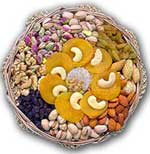
In addition to hot meals eaten at the gahambars, dried fruits and nuts called ajil or lork / lorg are distributed for the participant to take away. Ajil / lork is a mixture of seven (seven being the auspicious number) dried nuts and fruits: pistachios, roasted chic peas, almonds, hazelnuts, figs, apricots, and raisins (keshmesh). Some substitutions are made according to locale, availability, taste (salty or sweet) and family preferences. Roasted squash seeds (tokhmeh kadoo), roasted melon seeds (tokhmeh hendooneh), walnuts, cashews, and dried mulberries (tut) are possible substitutes.
Ajil is sometimes called ajil-e moshkel-gosha meaning problem-solving nuts or ajil-e moshkel-asan meaning problem-easing nuts.
 |
| Lork / lorg, a mixture of nuts and dried fruits. Image credit: Nazanin Niknam at vcn. The vcn site also shows images of other traditional Iranian-Zoroastrian foods. |
Sharing & Building Community
 |
| While this image is of the sharing a meal together after the navjote ceremony, the sharing of a meal at a gahambar in India used to look similar. Note the banana leaves used as disposable plates, an Indian custom that is now dying out. |
|


Recommended image sites:
» vcn
» Amordad Magazine
» Antoni Mysliborski (sengir) at Trekearth
» Site Contents
• © Author: K. E. Eduljee, Zoroastrian Heritage, 2005-23 (researched from 1979 onwards) • Contact • Page validated by W3C.org