Contents
Balkh
|
Overview
Balkh & Zoroastrianism
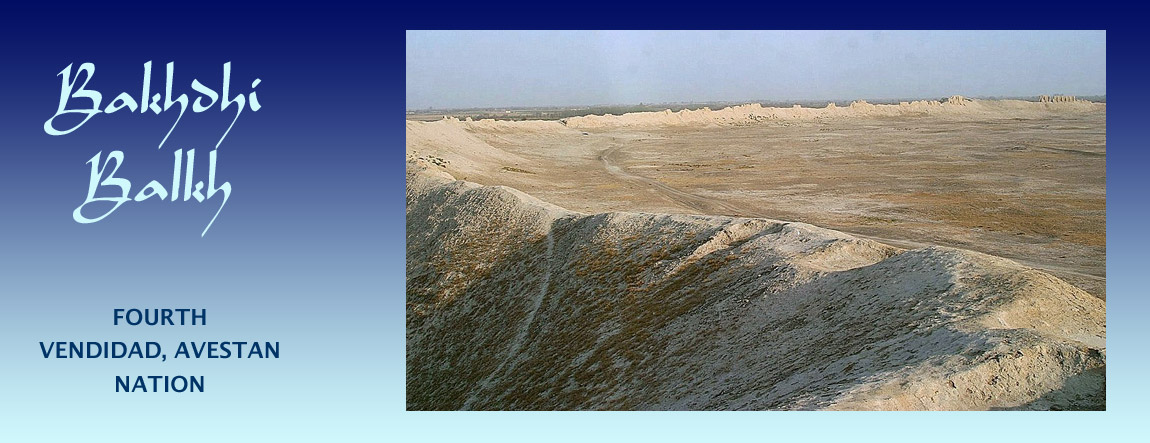
Bakhdhi is the fourth nation in the Avestan Vendidad's list of nations - Airyana Vaeja (homeland of the Aryans) being the first. Bakhdhi is the ancient Avestan name while Balkh is the modern name for both the region and its old capital city.
During the middle period of Aryan history - as the Aryans moved west from Airyana Vaeja towards present day Iran - Bakhdhi (Balkh as its is known today) became the principle kingdom of the Aryan confederation of kingdoms called Airan, and the eponymous city of Balkh was its capital. As the seat of Aryan rule moved westward to what is the Iranian province of Khorasan today, Balkh became part of greater Khorasan and remained an important regional capital as well as a cultural and trading centre.
According to Ferdowsi's Shahnameh, it was during this middle period of Aryan history that Zarathushtra (in later language, Zardhusht) carried his message (see Shahnameh page 30) to the kingdom of Bakhdhi [this is, however, a latter tradition. Bakhdhi is not mentioned in the Farvardin Yasht which lists four nations connected with Zarathushtra's ministry. For a further discussion on the lands of Zarathushtra's ministry see our page on Airyana Vaeja]. One latter tradition informs us that Zarathushtra established himself and died in Balkh. Some authors conclude that in addition to Bakhdhi / Balkh being one of the areas of Zarathushtra's ministry, that he was also born in Bakhdhi / Balkh. The Avesta, however, states that Zarathushtra was born in Airyana Vaeja (cf. his father's house was in Airyana Vaeja), and the Vendidad lists Airyana Vaeja and Bakhdhi as separate nations, Airyana Vaeja being the first and Bakhdhi the fourth.
Given that the traditions speak to Zarathushtra being born in Iran Vej (Middle Persian for Airyana Vaeja)
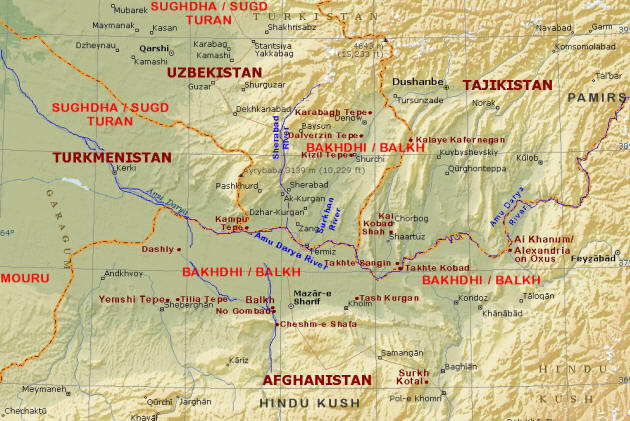
Bakhdhi would come to be known as Bakhtrish during Achaemenian times (675 - 330 BCE), Bactra city and greater Bactria from the Greek version of its name during Alexander's and the Seleucid occupation (330 - c. 246 BCE), and briefly Takharistan or Toharistan after the overthrow of the Seleucids. In 246 BCE, allied with Parthava (Parthia), Bakhdhi (Balkh) was one of the first Aryan nations to revolt against Seleucid rule. The "great and noble city" as Marco Polo called it, was destroyed by first by the Arabs and eventually by Mongols in 1220CE. Today, the site of the kingdom and its ancient city is called Balkh, and the once mighty kingdom has been reduced to the fairly small province in Afghanistan. Balkh's provincial capital is now Mazar-e Sharif, a city some twenty kilometres east of Balkh city. Our discussion on Bakhdhi includes the Greater Bakhdhi lands (see map above).
Kayanian Dynasty
Balkh's King Vishtasp (in later language, Gushtasp), a king of the Kayanian dynasty, was a contemporary of Zarathushtra. Vishtasp accepted Zarathushtra's teachings and became the patron king and defender of Zarathushtra's Mazdayasni faith.
The founder and first king of the Kayanian dynasty was Kai Kobad (also spelt Kay Qobad or simply Kaikobad) known to the Zoroastrian scriptures, the Avesta, by his older name Kavi Kavata. On the north Tajikistan bank of the Amu Darya River, close to the archaeological site of Takht-e Sangin, is a site called Takht-e Kobad meaning the throne of Kobad. About 40 km to the north along the banks of a tributary of the Amu Darya lies another site called Kai Kobad Shah meaning King Kai Kobad. We are not aware of any other region that ties itself so directly with the Kayanians.
There is an enigmatic section of the Middle Persian Zoroastrian text, the Denkard at verse 34 of Book 7 regarding the inheritance of the Aryan Farr (the Khvaraneh) by Kai Kobad and from Kai Kobad as E. W. West translates, "it came to Patakhsrobo, son of Airyefshva, son of Taz, who was king of the Arabs...". In verse 35, the farr goes to Kay Arash, a descendant of Kai Kobad. For some reason, the word "Taz" or "Tazi" in medieval Iran (Persia) came to be associated with the Arabs perhaps because it was a homonym with a similar sounding word denoting an Arab group. Such a translation in this context creates a disruption for the inheritance or passing of the farr from one king to the next also defines the genealogy of Aryan kings and it would seem odd that an Arab would be inserted as king between two Kayanian kings. Other writers have suggested that the word "Taz" in this context specifically applies to the Tajiks.
Topography of Balkh
 |
| Near Mazar-e Sharif (present provincial capital) |
 |
| Salang valley |
|
History very literally flows through and around Bakhdhi. The central portion of a river famous in legend and history, the Amu Darya River - the section that is downstream from the Sherabad River - formed the border between Bakhdhi and Sughdha (the second ) in the northwest of Bakhdhi. The upper part of the Amu Darya River - upstream from the Sherabad River - ran through the heart of eastern Bakhdhi until it entered the Badakhshan / Pamir region. Across the Amu Darya, the kingdom of Sugd lay to the north, while the Badakhshan region and Pamir mountains lay to the east and northeast. The kingdom of Mouru (Merv) lay to Bakhdhi's northwest and west, and the kingdom of Haroyu (Harirud) lay across its south-western border.
The southern and south-eastern borders of Bakhdhi was formed by the Hindu Kush (meaning Hindu killer) mountains. The name Hindu Kush leads us a believe that the fifteenth Avestan nation, Hapta Hindu, the seven Indus lands, lay across the Hindu Kush, the mountains forming the border between the two nations, and further that the relations between the two neighbours on either side of the Hindu Kush were not always peaceful.
 |
| The Hindu Kush mountains |
 |
Balkh's desert
|
 |
| A modern-day mini caravan |
The topography of ancient Bakhdhi included the varied landscape of fertile plains, deserts and rugged mountains. Balkh's desert lies to the north towards the Amu Darya River. The desert is famous in the legends of Ferdowsi's Shahnameh.
The kingdom was renowned through the known world for it beauty, abundant crops, and a large variety of fruits. There are several almond and apricot orchards. While certain parts of Balkh are still relatively fertile, war and poor leadership has reduced the once famed land to a dusty shadow of its former self.
In ancient Bakhdhi, an excellent breed of sheep was raised in green lower slopes of the Hindu Kush mountains. Bakhdhi was also famous for a breed of camels known today as the Bactrian camel.
Bactrian Camel
 |
| Bactrian camel |
The two-humped Bactrian camel was, if we may be forgiven this term, the work-horse of the caravans that plied the Silk Roads radiating north and south, east and west out of Bakhdhi. It was particularly suited to this task for it could carry heavy loads over great distances and through extremes in climate and temperature - from freezing cold to blistering heat.
While the Silk Roads have long since fallen into disuse, the Bactrian camel is still prized throughout the region as a beast of burden.
The camels have a remarkable ability to go without water for months at a time, but when water is available they can drink up to 57 litres at once. When well fed, the camels store excess food in their humps which become plump. When food is not readily available, the camel uses this stored food and the humps shrink and lean to one side. They are steady walkers and fast runners. They can walk consistently for hours at an end, and they have been recorded as running at speeds up to 65 kmph / 40 mph. As pack animals, they are able to carry 170-270 kg / 375-600 lbs at a rate of 47 km per day, or 4 kmph over a period of four days. They can swim. see well and have a keen sense of smell.
It is no wonder that they were the preferred pack animal for caravans, and they must have played a significant role in Bakhdhi being a major trading centre on the ancient Silk Roads.
Bones of the camel have been found in the region dating back to the first half of the third millennium BCE. By the late third and early second millennium BCE, images of the Bactrian camel were being used in the iconography of copper stamp seals and figurines found in the Kopet Dag hills of neighbouring Turkmenistan, but which are thought have originated in Bakhdhi / Bactria.
Silk Roads Trading Centre

|
| A caravan using Bactrian camels |
As with all the other Avestan Vendidad nations, Balkh lay on the Aryan Trade Roads (also called the Silk Roads) and was a significant centre of trade as well as caravan a stop over point. Balkh lay at the junction of the east-west route (between China and Asia Minor) and the north-south route between Merv, the northern lands beyond and India in the south. The route through Balkh was the preferred route for traders between the west and India as it was shorter and provided the easiest route through the Hindu Kush.
Even today, the Provincial capital Mazar-e Sharif is an important trading centre, importing goods for distribution throughout Afghanistan and exporting goods to the rest of Central Asia. Locally grown almonds and apricots as well as other dried nuts and fruits have their own bazaar and are exported. A fledgling silk industry, a traditional Aryan occupation, has also started to re-emerge.
Multi-Ethnic Population
There is perhaps no greater testimony to Bakhdhi / Balkh being at the cross-roads of the Aryan world and trade than its multi-ethnic population. Broken up today into a multitude of northern Afghan provinces, greater Bakhdhi / Balkh is home to several ethnicities native to its surrounding regions. The pared-down province of present-day Balkh has a majority Tajik population (which may speak to the original Aryan migration from the east) surrounded by Uzbek and Turkmen populations. Also present are Pashtuns and Hazaras. In war ravaged Afghanistan, Balkh is a relatively peaceful province.
The languages spoken are Dari Persian spoken by ethnic Tajiks (50%), Pashto (27%), Turkmen (11.9%) and Uzbek (10.7%).
The Buzkashi is a team sport and a public tournament where the goal is for riders to grab the carcass of a goat or calf (often headless) from the ground while riding a horse at full gallop and to pitch it across a goal line, into a target circle, or into a container. Opposing riders try to stop others from picking up the carcass or carrying it to the goal. The opposition can be fairly violent.
External page of interest:
» Bactrian Documents from Ancient Afghanistan
» Top
|