
Saka gold belt from Tillia Tepe, Afghanistan
Image credit: Wikipedia

Contents
Sakas
Page 1
Page 2
Page 3
Page 4
Page 1: Saka, Origins, Scythia, Dahi, Parthava (Parthia), Seistan, Rustam
Related reading:
» Khvarizem (Uzbekistan)
» Dahi (Dahistan)
» Parthava (Parthia)
» Far Eastern Lands. Phryni & Seres, Tashkurgan, Khotan, Kashgar, Yarkand
» Iranian-Aryan Connections with Western Tibet
» Kangdez - Far Away Land Beyond the Seas
» Great Ocean Vourukasha / Frakhvkard / Varkash
Introduction to the Saka
The Saka included groups who were part of the Zoroastrian and Aryan families of nations. They included the Chorasmi from Khairizem / Khvarizem / Khwarezm (Gk. Chorasmia), the Parthava (Parthians), the Dahi (Dahae) and the Sistani.
The largest number of ancient Zoroastrian related ruins and artefacts, including a dakhma, a Zoroastrian burial tower known as a 'Tower of Silence', have been uncovered in Chorasmia / Khwarezm. The Dahi were one of the first five nations or people amongst whom Zarathushtra preached his message. The Parthava (Parthians) liberated Iran-Shahr from Macedonian rule and reconstructed the Zoroastrian scriptures, the Avesta that had been destroyed by Alexander. Sistan's heroes, Sam, Zal and Rustam, were the pahlavans, the strongmen and protectors of the imperial Iranian throne. Their stories occupy the largest sections in Ferdowsi's epic poem, the Shahnameh.
For the main part, the traditional land of the Saka forms part of Turkmenistan, Uzbekistan, Kazakhstan and
Kyrgyzstan today.
 |
| Map of Saka lands- Modern. Click to enlarge |
Herodotus (485 BCE - c. 420 BCE) and Strabo (c. 63/64 BCE - 24 CE) described the Saka (Sacae) in general as nomads who engaged in perpetual warfare plundering their neighbours and far off lands. However, Strabo and Herodotus mention exceptions to this generalization. Their comments together with supporting evidence indicate there were both settled and nomadic Saka. Strabo sums up the reputation of the Saka as follows: "They are self-assertive, uncouth, wild, and warlike, but, in their business dealings, straightforward and not given to deceit."
Saka and Scythians
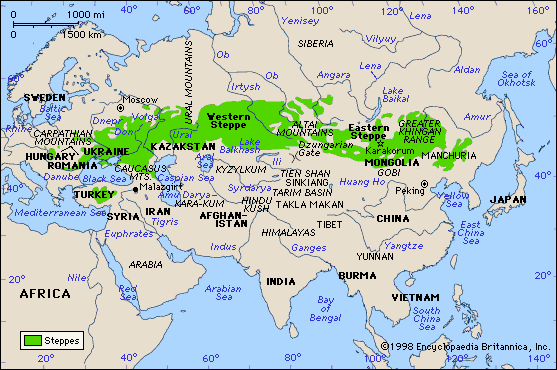 |
| Map of Eurasian steppes or grasslands Scythia occupied the grasslands of Ukraine. The grasslands of Asia are to the north of Saka lands, which were around & to the south of the Aral Sea. |
The Central Asian Saka (Sacae) and the European Scythians are very often referred to as the same people in books on the subject. Unfortunately many authors of European origin display a strong Euro-centric bias in their writing. These authors find support for their bias in the work of classical Greek writers who loosely called all the peoples who lived on an immense swath of land - land that became in modern times the Russian Empire - as Scythian. That was because these people lived - in the estimation of the ancient Hellenic writers - a similar Scythian-like lifestyle. That life-style was a broad approximation of what they called the nomadic lifestyle of the people living in the Eurasian grasslands - the steppes.
The people caught in this broad approximation were and are ethically very different: from light haired Europeans - to Mongolian-like peoples - to the Iranian-Aryans. Nor were all these people nomadic. The differences between the dwellers of the Ukrainian steppes, those who dwell in arid lands of Turkmenistan, and those who reside in the expanses of Mongolia are evident today even to the casual observer.
The confusion between the Saka and Scythians in classical literature is understandable since many classical writers had to rely on third-hand information on which to base their accounts, and because some of the groups were only loosely organized as coherent communities - at least in the estimation of outsiders. Greeks and other Europeans rarely travelled through the Eurasian grasslands or east beyond Persia (Western Iran). The Hellenic authors wrote from their frame of reference. They were familiar with the characteristics of the Scythians. Unfortunately many modern writers are doing the same. Today, however, we have the benefit of a more comprehensive approach and a wide data base. Pliny sums up the difficulty faced by classical author in his Natural History, Book 6, Chapter 19, by saying, "Indeed, upon no subject that I know of are there greater discrepancies among writers, from the circumstance, I suppose, of these nations (Saka) being so extremely numerous, and of such migratory habits."
 |
| Scythia. Image credit: Encyclopedia of Ukraine (click for a larger map) |
Scythia itself was a fairly small nation. The father of modern history, Herodotus, states the extent of Scythia in his Histories 4.21: Travelling west to east, "Across the Tanais (commonly today's Don River in the Ukraine) it is no longer Scythia; the first of the districts belongs to the Sauromatae, whose country begins at the inner end of the Maeetian lake (commonly taken to mean the Sea of Azov at the north of the Black Sea) and stretches fifteen days' journey north, and is quite bare of both wild and cultivated trees. Above these in the second district, the Budini inhabit a country thickly overgrown with trees of all kinds."
From about 800 to 300 BCE, the Scythia of Greek texts (also see Herodotus 4.21 above) extended east from the Carpathian Mountains in Central Europe - that is east of Rumania, Eastern Ukraine and Poland of today - east from the Carpathians to the Don River. To the south of Scythia was the Sea of Azov (the Maeetian Lake) and to the north, the start of the forests.
In other words the land of Scythia was a relatively small country that consisted of the grasslands of today's Moldova, Ukraine and Crimea. It was far removed from the eastern Saka lands and people. Certainly, as with any group in history, there would have been contact through conquest, plundering raids and even trade resulting in an osmosis of language elements and a borrowing of words. Nevertheless, in our investigation on the Saka, we have found no ethnic link between the Scythians and the Saka. Nor have we found an instance of the two forming a single community. Indeed, if we read the classical Greek accounts careful, we find it stated that the origins of the Saka are to be found in the east as part of the Central Asian Aryan family and not the west. As we shall see below, the Saka's links as well as their making or breaking of community are found with the Aryan and Zoroastrian family of nations.
The Saka were not Scythians - nor any variation thereof.
[Reader's need to make allowance that many ancient and modern writers were and are not scientific or circumspect in their writing. Many filled the gaps in their information with their imagination or skewed information to support a political or racial motive. For instance, Greek writers added to their substantive and convoluted mythology that the nations of Persia (and Media) were formed by Greek gods. Expropriators of The Irano-N. Indian Aryan heritage (including symbols) claim eastward migrations of their 'race'. Other machinations had the Caucasus Mountains as a birthplace of the white Caucasian 'race'. At one time, the Soviet Russians actively promoted the concept of eastward 'Scythian' migrations perhaps to bolster their imperial acquisition of the once Saka lands in Central Asia. Also see our page: Western Views on the Aryans. We are, however, pleased to see some modern writers beginning to voice a contrary opinion to the old Eurocentric bias. Wikipedia's page of Scythian Languages starts with the statement, "The Scythian languages are a group of Eastern Iranian languages of the classical and late antiquity (Middle Iranian) period...." While we feel it is untenable to link language associations categorically to genetics (or race) as so many linguists and philologists attempt to do, or to equate the spread of languages solely to migrations of 'races' (race-based constructs provide racists with academic support and thereby legitimacy for their bogus postulations), and while the Wikipedia page persists in using the term 'Scythian' in contexts where 'Saka' is the correct and authentic term, the page nevertheless provides some refreshing insights.
Some authors such as Oswald Szemerényi imply that the Sogdians were Scythians i.e. Saka. The Sogdians and various Saka are listed as separate groups in Achaemenid inscriptions. The Sogdians and Saka though separate did live in close proximity and there are indications that some Saka did inhabit parts of Sogdian lands at different points in history. When times of mutual accommodation gave way to competition, there were likely repeated inroads of one group into the lands of the other.]
Herodotus & Pliny on the Saka
At 7.64 of his Histories, Herodotus makes a revealing statement, "Σάκαι δὲ οἱ Σκύθαι...", i.e., "Sákai dé oi Skýthai", which translates as, "The Sakai (Sakas) who are Skythai (Scyths)...." A sentence later, "τούτους δὲ ἐόντας Σκύθας Ἀμυργίους Σάκας ἐκάλεον: οἱ γὰρ Πέρσαι πάντας τοὺς Σκύθας καλέουσι Σάκας" i.e., "toútous dé eóntas Skýthas Amyrgíous Sákas ekáleon:̱ oi gár Pérsai pántas toús Skýthas kaléousi Sákas.", which translates as, "But these (people) are in reality called Amyrgyian* Sakas. For the Persians call all those Scythians, Sakas." Most translators do not translate τοὺς/toús (epic form of ὁ, 'the following' and here 'those', a demonstrative pronoun), leaving the phrase to incorrectly read "...the Persians call all Scythians, Sakas." The exclusion of τοὺς/toús changes the meaning of the phrase substantially. [*5th cent. BCE Greek historian Ctesias in his Persica at § 3 has Amorges as king of the Sacae in the time of Cyrus. Polyaenus (2nd. cent. CE) in his Stratagems at vii. 12 has Amorges as king at the time of Darius. 'Amorg' is likely derived from the Old Iranin/Avestan 'amer' meaning 'immortal'.]
Compare our translation to the statement by Roman natural historian Pliny (23-79 CE) in his Natural Geography at 6.19: "Ultra sunt Scytharum populi. Persae illos Sacas universos appellavere a proxima gente, antiqui Aramios, Scythae ipsi Persas Chorsaros et Caucasum montem Croucasim, hoc est nive candidum". For the primary translation of this passage, we get, "Beyond* (the Jaxartes River/Syr Darya mentioned previously in 6.18) are the Scythian people. The Persians call all as Saka after the nearest people, the ancient Arami, Scythians themselves Persians Chorsares (Chorasmian?*) and/also the Caucasian Mountain Croucasis, that is snow white/whitened (cf. Safeed Kuh/Paropamisus)." We get a secondary translation by inserting 'call': "Beyond (the Jaxartes River/Syr Darya) are the Scythian people. The Persians call all as Saka after the nearest people, the ancient Arami, Scythians themselves (call) Persians Chorsares (Chorasmian?**) and/also (call) the Caucasian Mountain Croucasis, that is snow white." [*"Beyond" the Jaxartes means east of the Jaxartes. **Khor in Old Iranian = Sun; as in Khorasan and Khorasmia/Chorasmia.]
Significantly, Pliny places his description of the 'Scythians' after his chapter on the Caspian Sea and before his chapter on the Seres (eastern most lands). His passage states (as does Herodotus) that the Persians call all those 'Scythians" descended from the Arami as Saka. 'Aram' is an Irano-N. Indian word. It could also be a corruption of Herodotus' 'Amyrgi'. Pliny lived during the Parthian reign of Aryana and we also know of Parthava as Khorasan. This might explain Pliny's statement regarding the "Persians Chorsares". Paradoxically, even though the West called the Parthians under the general appellation of 'Persians', the Parthians were originally a Saka group.
A note by Maj. Gen. Sir A. Cunningham in his article (at p. 223) published in the Royal Numismatic Society's Numismatic Chronicle (Great Britain, 1888) states, "In the Babylonian version of the inscriptions of Darius (likely at Behistun), Namiri (N'amiri?) is substituted for Saka. Perhaps Aramii should be Amarii." King Darius' inscription at Behistun that chronicles a secession by the Saka Tigra-Khauda is on column five. Gen. Cunningham's note indicates a possible relationship between 'Arami', 'Amyrgi' via 'Amiri' and the
Saka Tigra-Khauda.
Darius in responding to the secession of the Saka Tigra-Khauda, states in his inscription that went he marched with his army to the Saka lands, he crossed a 'draya', a river, likely today's Syr Darya before encountering the Saka. Modern translators inevitably translate 'draya' as 'sea' and therefore translate 'para draya' incorrectly as 'across the sea'.
Location & Composition of the Saka
The region described below consists of today's Turkmenistan and Uzbekistan and parts of Kazakhstan and Kyrgyzstan.
{In the passages below we have replaced the word Scythian with [Sacae].}
Strabo (c. 63/64 BCE - 24 CE), in his Geography 11.8.1,
writes: "As one proceeds from the Hyrcanian Sea towards the east, one sees ... the tribe of the Parthians (Parthava) and that of the Margianians (Mouru) and the Arians; and then comes the desert which is separated from Hyrcania (Verkani/Gorgani) by the Sarnius River as one goes eastwards and towards the Ochus (Murghab) River...Then comes Bactriana, and Sogdiana, and finally the [Sacae] nomads."
In the account above, travelling west to east, Strabo's sources encounter the Saka beyond, i.e. east, of the Sogdians. Since the Syr Darya (River Jaxartes) formed the eastern Sogdian border, that would place those Saka to the east of the river. However, Strabo adds below, that the Saka are also to be found on the left (north) of the traveller starting with the Dahi who lived to the north of
Varkana and Parthava (Hyrcania and Parthia) immediately after the Caspian, followed by the great Karakum
(Garagum) desert, and then the Massagetae.
Strabo 11.8.2: "On the left and opposite these peoples are situated the [Sacae] or nomadic tribes, which cover the whole of the northern side. Now the greater part of the [Sacae], beginning at the Caspian Sea, are called Däae (Dahi), but those who are situated more to the east than these are named Massagetae and Saca, whereas all the rest are given the general name of [Sacae], though each people is given a separate name of its own. They are all for the most part nomads. But the best known of the nomads are those who took away Bactriana from the Greeks, I mean the Asii, Pasiani, Tochari, and Sacarauli,
who originally came from the country on the other side of the Iaxartes (Jaxartes or Syr Darya or Sihun) River that adjoins that of the Sacae and the Sogdiani and was occupied by the Sacae. And as for the Däae, some of them are called
Aparni* (see below), some Xanthii, and some Pissuri. Now of these the Aparni are situated closest to Hyrcania (Verkani/Gorgani) and the part of the sea that borders on it, but the remainder extend even as far as the country that stretches parallel to Aria."
Strabo 11.8.3: "Between them (Sacae) and Hyrcania and Parthia and extending as far as the Arians is a great waterless desert, which they (the Sacae) traversed by long marches and then overran Hyrcania (Verkani/Gorgani), Nesaea (Nisa), and the plains of the Parthians
Parthians (Parthava).
To paraphrase the above: various Saka groups, Saka being a general term, inhabit the northern plains that stretch from the Dahae lands that lie to the east of the Caspian Sea all the way to Aria (today's
Herat Afghanistan), and that between these Saka and the southern kingdoms of Hyrcania (Varkana/Gorgan), Nesaea (Nisa), the plains of the Parthians (plains just north of the Kopet Dag, Bactria (Northern Afghanistan) and Aria lies a great desert that some of the northern predatory Saka tribes crossed by long marches to raid the kingdom along the south of the desert and particularly Varkana, Nisa, and the Parthian plains. The Saka who lived beyond the Jaxartes River (Syr Darya) coincides with Saka Para-Darya, the 'Saka across the river'. The name
Aparni* (see above) is found in the Middle Persian Zoroastrian text, the Bundahishn as Aparnak, one of the six male children of the legendary Saka king, paladin and champion of Iran-shahr, Sam, Rustam's grandfather. Aparnak was given over-lordship of the land of Aparshahr derived from Aparnak-shahr. The Aparni were apparently a royal house of the Dahi.
According to Strabo, the Saka consisted of:
- an eponymous group called the Saka as well as
- Dahi (largest) consisting of the clans such as the Aparni, Xanthii, and Pissuri and who were situated closest to the Caspian Sea
- Massagetae (who were situated east across the desert - today's Karakum/Garagum), and
- Asii, Pasiani, Tochari, and Sacarauli who original came from east of the Jaxartes (Syr Darya) and located presumably between the Oxus (Amu Darya) and Jaxartes (Syr Darya). The name Sacarauli appears to be Saka-rauli.
Unlike Strabo, Pliny in his Natural History at 6.19 (see above), does not mention any Saka (Sacae) nation west of the Jaxartes (Syr Darya). Those Saka that others understand as living west of the Jaxartes, Pliny names and the places in the east, but admits, as we have quoted above, "Indeed, upon no subject that I know of are there greater discrepancies among writers...." His account states that the Sacae (Saka) occupied lands east of the Jaxartes. His enumerates the Saka groups as follows:
The Saka groups are the, "Sacae (here spelt differently than his previous spelling of Sakas), the Massagetae, the Dahae, the Essedones (Issedones situated in today's Kyrgyzstan?), the Ariacae (They dwelt, according to Ptolemy, along the southern banks of the Jaxartes), the Rhymmici, the Paesici, the Amardi (Mardi, near Caspian), the Histi, the Edones, the Camae, the Camacae, the Euchatae (today's Bukhara?), the Cotieri, the Anthusiani, the Psacae, the Arimaspi, the Antacati, the Chroasai, and the Cetei; among them the Napaei are said to have been destroyed by the Palaei.
"The rivers in their country that are the best known, are the Mandragæus and the Carpasus. ...He (M. Varro) adds also, that under the direction of Pompey, it was ascertained that it is seven days' journey from India to the river Icarus, in the country of the Bactri, which discharges itself into the Oxus, and that the merchandize of India being conveyed from it through the Caspian Sea into the Cyrus, may be brought by land to Phasis in Pontus, in five days at most. There are numerous islands throughout the whole of the Caspian sea: the only one that is well known is that of Tazata."
Parthian Saka as a Part of the Aryan Nations & Zoroastrian Family
Parthia (Parthava) as an Iranian kingdom was in existence around 1000 BCE. It was a successor nation to Nisaya, the fifth nation mentioned in the Zoroastrian scriptures', the Avesta's, book of Vendidad (see Vendidad nations). As a result, it is sometimes known was Parthaunisa. The Parthians liberated Iran-Shahr for Macedonian-Greek rule left behind by Alexander. They reassembled the Iranian federation of kingdoms, Iran-Shahr and they also reassembled fragments of the Zoroastrian scriptures, the Avesta destroyed by Alexander (see our page on the destruction and recompilation of the Avesta).
The Parthians are thought to be a part of Dahi-Saka, (Dahae in western literature) a part of the greater Iranian-Aryan family that had its origins in an area around the upper reaches of the Syr Darya (Jaxartes) river. The Dahi migrated 1,500 km westward towards land around the southeast Caspian coast and the Kopet Dag mountains. The Dahi are mentioned in one of the oldest chapters of the Zoroastrian scriptures, the Avesta, as one of the five original people to accept Zarathushtra's message, i.e. become Zoroastrian.
The Parthava may have in this manner shared origins with the ancestors of legendary Rustam of Sistan. The strongmen of both groups are called pahlavans, a word related to Pahlavi, a later form of Parthava. The Parthava in turn have Saka roots. The Saka pahlavans were protectors of Iran-Shahr and the Iranian throne, a role they would fulfil very well when they liberated Iran-Shahr from Macedonian rule. The word Sagzi is used in as a title for Rustam with the implication that the word is derived from Sakzig, a derivative of Saka. [We find Sakzig reminiscent of Tagzig (commonly thought to be Tajik), the nation where the Tibetan Bon claim spiritual roots.]
Dahi & Zoroastrianism
The country of Dahi or Dahinam (-nam is a usual ending for many Avestan nouns) finds mention in the Zoroastrian scriptures, the Avesta's Farvardin Yasht 13.144 where the fravashis (spiritual souls) of the Dahi's men and women are revered. The implication is that the Dahi, or some Dahi, were Zoroastrians - Zoroastrians worthy of perpetual veneration in each recitation of the scriptures. Contemporaneous with the life of Zarathushtra, Dahi, together with Airya (-nam), Tuirya (-nam), Sairima (-nam) and Saini (-nam), are the oldest in the Zoroastrian family of nations - nations that participated in the start of the Zoroastrian era.
Original Homeland of the Saka
A strong candidate for the original homeland of the Saka is the land north of Airyana Vaeja, ancient Airya, around the upper to mid Syr Darya or Jaxartes river. Today, that region extends from the Fergana Valley in Tajikistan to Tashkent in Uzbekistan.
According to Justinus, internal discord between the Saka forced the Parthians to leave their original homeland and migrate to new lands. The Dahi (Gk. Dahae) did the same and both migrated nearly 1500 km westwards towards the Caspian Sea. [For a further discussion, please see our Dahi page.] The entire area in-between the upper Syr Darya and the southern Caspian were settled by different Saka groups. Some Saka would have migrated eastward into present-day Kyrgyzstan as well.
The Saka connection with Eastern Iran's Sistan region appears to have taken place via two routes. The first and the more ancient was via the connection with ancient Parthava (Parthians), the Pahlavans or Paladins of Iran-shahr. The second took place during the liberation of Iran-shahr from Macedonian-Greek rule about 2,100 years ago resulting in the formation of Sagastan (Sakastan).
 |
| Map of Iranian-Aryan Nations of Central Asian, Dahi lands & migrations. Click to see a larger map. Base Image Credit: Microsoft Encarta. Notations © K. E. Eduljee |
Sagastan - Sakastan. Sistan
Sagastan or Sistan is the ancestral kingdom of the legendary heroes of Iran, the protectors of the Iranian throne, the family of Sam, Zal and Rustam. The exploits of these heroes and their often stormy relationship with the Iranian-Aryan overlords, the king-of-kings occupy the bulk of the poet Ferdowsi's epic, the Shahnameh, the Book of Kings.
The name Sagastan (Sakastan, meaning the land of the Saka), and Sistan are relatively modern names. We do not find these names in the Zoroastrian scriptures, the Avesta or the Achaemenian inscriptions listing the nations of the Persian Empire (700-330 BCE) where we find the name Zraka or Zaranka (Gk. Drangiana) instead. The name Sagastan emerges in history during the Persian Sassanian empire (c. 200-650 CE) where we find the satrapy or kingdom of Sagastan located in the area of today's Sistan / Seistan province in eastern Iran. George Curzon in Persia and the Persian Question, vol 1 (1892), writes, "The derivation of the name Seistan or Sejestan from Sagastan, the country of the Sagan, or Sacae, has, says Sir H. Rawlinson, never been doubted by any writer of credit, either Arab or Persian." Not every writer shares Curzon's certitude.
In their flight from the invading Arabs c 650 CE, the Persians and their allies mounted significant resistance at Zarang in Sagistan (another name variation).
As we have stated above, the Saka connection with Eastern Iran appears to have taken place via two routes. The first and the more ancient was via the connection with ancient Parthava (Parthians), the Pahlavans or Paladins of Iran-shahr. The second took place during the liberation of Iran-shahr from Macedonian-Greek rule about 2,100 years ago resulting in the formation of Sagastan (Sakastan).
Kingdom of Rustam - Greater Sakastan. Connections with India
 |
| Lion Capital from Mathura, India reportedly containing the word Sakastanasa. Photo credit: Wikipedia |
According to Ferdowsi's Shahnameh, Rustam's grandfather Sam received from his overlord, King of Iran-Shahr, Manuchehr, a throne of turquoise, a crown of gold, a ruby signet-ring and a golden girdle. Manuchehr further gave Sam with a charter investing him him lands under his domain. These included:
• the whole of Kabul (Gandhara),
• Dunbur (derived from Sanskrit Udyanapura to Adynpur to Dunpur - a major city of Lamghanat, on the right bank of the River Kabul),
• May-e Hind (from Vay-hind, capital of Gandhara and the region between the Kabul and Indus rivers above their confluence),
• Land from the Darya-e Chin (Chen-ab River, an Indus tributary which irrigates Multan) to Darya-e Hind (Indus River),
• Land from Zabulistan to the other side of Bust/Bost (Lashkar-gah, Southern Afghanistan).
Similarly, Rustam's overlord Kayanian King Kay Qubad granted him a fiefdom from Zabulistan to the Darya-e Sind, with the throne and crown of Nimruz; and Kabul to be given to Mihrab. Maintaining the tradition, Kayanian King Kay Khusrow bestowed on Framarz, Rustam's son, the kingdom of all Hind from Qinnauj (derived from Sanskrit Kanyakubja to Kanauj, a region of the Ganges) to Seistan, Hind (Sind), Dunbur, May, Bust, Zabul/Zabol, Kabul.
These immense lands cover what is today Seistan and Baluchistan in Iran, Afghanistan northern Pakistan, Kashmir and a large part of northern India.
If this is indeed history in some form, then the greater quasi-empire of Sakastan, a sub-empire if you will of the greater Iranian-Aryan (later Persian) empire, included what the Persians refer to as Hind i.e. India, and there was ample opportunity for Saka influence in India. There is some suggestion - a very tenuous one - that we have evidence of the Sakas in India. In Mathura, North-Central India (north of Agra and on the banks of the River Yamuna, a tributary of the Ganges, is a first century BCE inscription on the Mathura lion capital "honouring all Sakastanasa" cf. Sakastan, meaning land of the Saka. That reading of the words is debated and in any event, the sub-empire of Rustam would have long predated the 1st century BCE.
» Page 1 » Page 2 » Page 3 » Page 4
Related reading:
» Khvarizem (Uzbekistan)
» Dahi (Dahistan)
» Parthava (Parthia)
» Far Eastern Lands. Phryni & Seres, Tashkurgan, Khotan, Kashgar, Yarkand
» Iranian-Aryan Connections with Western Tibet
» Kangdez - Far Away Land Beyond the Seas
» Great Ocean Vourukasha / Frakhvkard / Varkash
» Site Contents
• © Author: K. E. Eduljee, Zoroastrian Heritage, 2005-23 (researched from 1979 onwards) • Contact • Page validated by W3C.org