|
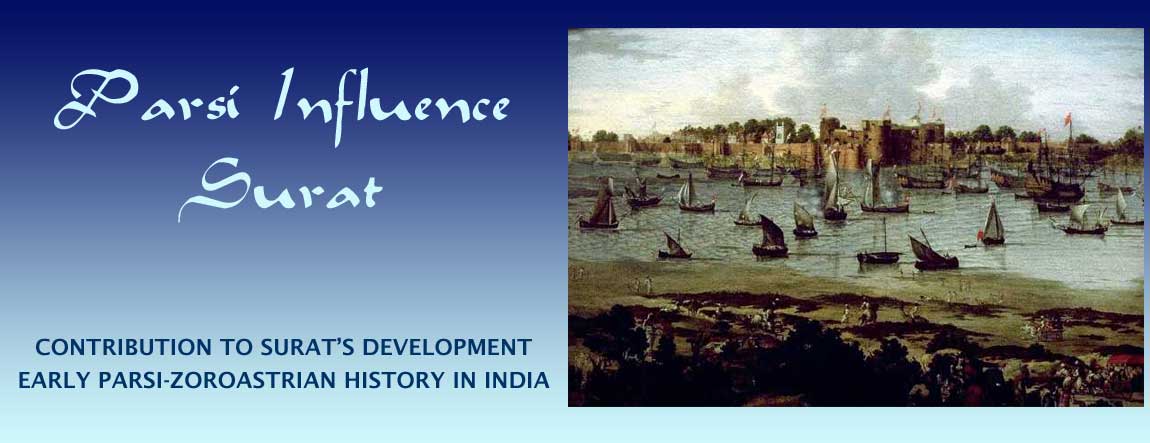
Port of Surat end of 17th century. Painting at Amsterdam. Rijksmuseum Stadhouderskade. Painter: Dutch Anonymous. Photo Credit: sjsu.edu/encounters |
Page 1Suggested prior reading:» Destruction of Sanjan, Gujarat, IndiaAssociated reading:» Early Parsi History. Escape from Iran» Early History of Mumbai's (Bombay's) Fire TemplesSurat - a Background
Surat is a coastal city and is today, the commercial capital of the Indian state of Gujarat. The city is located 230 km south of state capital of Gandhinagar and 250 km north of Mumbai. The Tapi / Tapti River runs past the city which is some 25 km from the river's mouth at the Arabian Sea. A moat surrounds the old city which is distinguished by its narrow streets and quaint houses. Surat is famed as the textile capital of India and the diamond capital of the world - for 92% of the world's diamonds are cut and polished in Surat.
Surat - Earlier History & Muslim Conquest
In 1206, Muslim rule was established in Delhi and the new Sultanate quickly began to spread its influence and control. In 1297, the Muslim Sultan Allaudin Khilji launched a campaign under the command of Altaf Khan to conquer and subjugate Gujarat then ruled by King Karan Vaghela, (a possible descendant of King Jadav Rana). The Muslim armies destroyed the wealthy port of Khambat (Cambay), took control of Surat and pillaged the other towns and cities. The Zoroastrians population of Surat and Gujarat who had five centuries earlier fled Muslim rule of Iran, would now once again come under Muslim domination.
On December 23, 1534 Bahadur Shah was compelled to sign the Treaty of Bassein [on Salsette (Sashthi) Island and beside the Bombay islands. Also see our page on Konkan-Thana] with the Portuguese on board the galleon St. Mattheus. According on the terms of the agreement, the Portuguese Empire gained control of the city of Bassein, as well as its territories, islands, and seas. Bahadur Shah concluded a further treaty and alliance with the Portuguese in order to help resist Mughal incursions onto Gujarat, but the unfortunate sultan was murdered by the Portuguese on February, 1537 during discussions a Portuguese ship anchored off the coast of Diu in Gujarat, and the Portuguese unceremoniously dumped his body into the Arabian Sea (see image to the left).
In the latter half of the 1600s, Bombay had still not reached prominence it held in later years. At that period in history Surat (population 200,000) was the chief trading port of Gujarat, the status it inherited with the decline of Khambat (Cambay) caused by heavy silting at the head of the Gulf of Khambat at the close of the fifteenth century, and also after the destruction of Diu by the Muscat Arabs in 1670.
Towards the end of the 17th century, Surat would start to loose it claim to being the capital of the Zoroastrian community in India. At that time, the British had just taken over and consolidated their hold of the islands of Bombay. And the British soon moved to expand their control to the outlying regions around Bombay as well. The Parsees were happy to move out from under Muslim yoke in Surat to the less oppressive environment of Bombay. A further incentive for the migration of Parsees to Bombay was a famine that desolated Gujarat. In the next two centuries following the 17th century CE, a large number of Parsees (and a significant number of recent Zoroastrian refugees from Iran as well) would move to Bombay and help Bombay, in they same manner as they had helped Surat, become the commercial and trading capital of India.
The Zoroastrian Parsees of Surat - TradersConnections with the Gujarati Based Vania
When Anquetil du Perron visited and stayed amongst the Parsees of Surat in 1759 CE, he found the Parsees intermingled with the 'Banians', that is the Banias or Vanias of Gujarat [the Indian leader (Mohandas) Mahatma Gandhi belonged to the Gujarati Bania caste]. The Vanias were a part of the Hindu Vaishya caste of traders, business-people engaged in commerce and finance, jewellery-makers and agricultural land owners. The term Vania, however, is usually applied to the more wealthy of the caste. The word Vania is derived from 'Vaniji', which means 'trader' in Sanskrit. The titles used by the Vanias of Gujarat such as Modi, Shah, Shroff, Parikh, Chokshi, Seth and Gandhi, including Vania itself - were all adopted as last names by the Parsees. The professions of the Vania were also professions in which the Parsi immigrants to Gujarat were already engaged and to which they added an strong ethical dimension which set them apart.
Parsi Clothing Adopted From Their Gujarati Vania Hosts
Anquetil du Perron not only found the Parsees intermingled with the Vania, he also found they wearing the same clothing as the latter. To his eye, he found that the only garments that distinguished the Parsees from the Vania were the inner garment, the sudrah with its kusti, as well as the penon (padam), the mouth veil (however, the Parsees would have made subtle changes to the local garments - differences not evident to the Western eye). At that time, the padam was worn by not just by the priests as is done today, but the laity as well. The laity wore the padam on occasions such as praying and eating meals - a practice they have now discontinued. James Hastings in Encyclopedia of Religion and Ethics, Part 18 noted that in the early 20th century, the Parsee men were still faithful to the Vania dress by wearing the angarakha tunic, but nevertheless replacing the Hindu dhoti with trousers and Indian curved shoes with European shoes. The men further distinguished themselves from Gujarati Vanias by wearing a turban called a pagri over a skull cap.
Nanabhai Punjibhai (d. 1667)
|




|
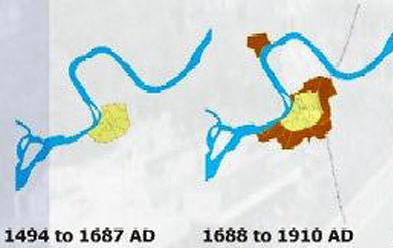
| The City of Surat, from a Dutch engraving reproduced in John Ogilby's Asia, London 1673. Image credit: The British Library |
|
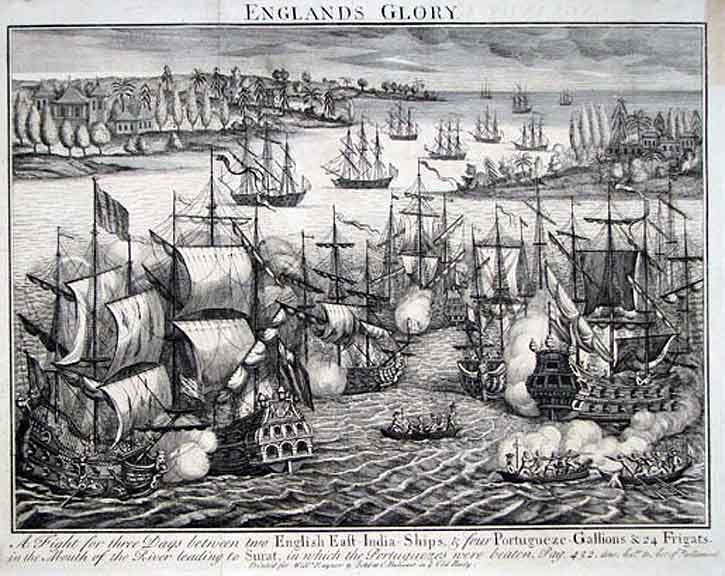
| England's Glory [the Battle of Swally, Surat, India.] "A Fight for three Days between two English East-India-Ships, & four Portugueze-Gallions & 24 Frigats. in the Mouth of the River leading to Surat, in which the Portuguezes were beaten. Done Accor. to Act of Parliament. Printed for Willm. Rayner & Sold at C. Danvars in ye Old Baily." [London, c.1739.] Between the 29th and 30th of November 1612, the naval Battle of Suvali (Swally) took place off the coast of Suvali, near the city of Surat, Gujarat, India; this relatively small naval battle resulted in a victory for four English East India Company galleons over a Portuguese fleet. This battle is historically important as it marked the beginning of the end of Portugal's commercial monopoly over India, and the beginning of the ascent of the English East India Company's presence in India. The etching was prepared as part of the patriotic series depicting British naval achievements, 'England's Glory'. It was published to promote a war with Spain agenda, and to undermine Prime Minister Robert Walpole's policy of avoiding military conflict. Etching by William Rayner (1699 - 1761). |
Nanabhai's family and descendants came to be known as the Parsi Modis of Surat. Modi (also spelt Mody) means supplier of provisions or the owner of a granary. Initially, the name was used as a title given to Nanabhai's family on account of the assistance and provisions they provided the English during their struggles with the Portuguese, Dutch and Muslims. When the British introduced the concept of family names, Nanabhai's descendants assumed Modi as their last name.
Nanabhai passed away in 1667 and the mantle of leadership of the Surat Parsi community was taken up by his heirs. The position of leadership was not nominal - the Modis were the recognized community leaders / headmen, or davars, and community representatives at the court of the Nawab of Surat, a position continued subsequently with the city's British administrators.
Office of Davar - Community Leader
While we do not know if this is true of the Surat Modis, davars were often legally entrusted with the ability to dispense common law justice and resolve civil disputes. They were given plenary jurisdiction over local community councils and members. Though the davar's powers diminished significantly during British rule, the British initially vested the Bombay Parsi Panchayat with many of the davar's powers. Regrettably, after a variety of challenges and accusations of favouritism, the powers of the davar and panchayats were reduced to informal roles and that of charitable institutions respectively.
The davar normally held open court in his premises and there was no limit to the number of community members who could attend an open hearing. The davar often consulted other senior members of the community (forming thereby a panchayat / panchayet or council, but nevertheless retaining plenary powers), before passing judgement that could include any punishment other than capital punishment. The range of punishment included confinement, fines or restitution, excommunication, banishment and exclusion from ceremonies. As there were no Zoroastrian community jails, incarceration was in the nasa-khana, or bier-room guarded by nasa-salars or corpse-bearers.
Zoroastrians seldom went outside this community system to seek justice. The system together with a strong community ethic was so effective that crime within the Zoroastrian community was the lowest among any other Indian community. The Zoroastrians also lived in quasi-gated neighbourhoods that excluded outsiders from entering.
Bhimji Kuvarji Modi
and His 1710-11 CE Petition to the Nawab of Surat
Muslim Attitudes Towards Zoroastrians
When less influence Zoroastrian Parsees were press-ganged by hostile and discriminatory Muslim officials into labour gangs for digging ditches and graves for Muslims, a descendant of Nanabhai Punjibhai, Bhimji Kuvarji Modi successfully petitioned Nawab Hyder Ali Khan to issue a farman (decree) exempting Parsees from this form of forced servitude to the Muslims.
As a result of the same petition, Bhimji was also successful in having the Nawab reverse the confiscation by Muslim magistrates called kazis of dues collected by the Zoroastrians for marriages. The dues were for the amelioration of disadvantaged poor Zoroastrians. The Nawab's 1710-11 farman prohibited the appropriation of the dues by the kazis so that they could be used for the intended purpose. It also prohibited interference by Muslim officials in religious and community affairs that were not connected with the execution of their office.
The Nawab's farman contained these words: "...the mutasudis (clerks), talukdars (district officers) and other Mussalmans regard the Parsees poorly, and by reason of religious hostility and in an arbitrary manner, force them to serve...".
As a further example of Muslim hatred towards Zoroastrians in Surat, we learn from Sir Streynsham Master's 1672 account (as quoted by Rustom Paymaster in Early History of Parsees in India) that the Parsees that the Parsees "had a church in Surat; but the tumultuous rabble of zealot moors destroyed and took it from them... ." (Also see our page on the Destruction of Sanjan.)
Western Accounts of the Zoroastrian-Parsees of Surat
Thevenot (1666) describes the goods in the markets of Surat as "all kinds of Indian cotton goods, all the wares of Europe and China; diamonds, rubies, pearls and all kinds of precious stones; musk, amber, myrrh, incense, manna, sal ammoniac, quicksilver, lac, indigo, and the red dye ruinas, and all kinds of Indian and other eastern drugs." The chief articles of export were agates, carnelians, desks, cabinets, and boxes neatly polished and embellished, silks, velvets, taffetas, satins and cotton cloth. Next to the manufacture of cloth, one of the most important industries was ship building.
Ogilby in his Atlas V. (1670) p. 218-19, notes, "They (Parsees) live like the natives, free and undisturbed, and drive what trade they please. They are very ingenious, and for the most part maintain themselves with tilling and buying and selling all sorts of fruits, tapping wine out of palm trees. Some also trade and are exchangers of money, keep shops, and exercise all manner of handicrafts... ."
According to Ovington in a Voyage to Surat (1689), Zoroastrian-Parsees played a significant role in the textile and ship-building industries. "In their callings, they (Parsees) are very industrious and diligent, and careful to train up their children to art and labour. They are the principal men at the loom in all the country, and most of all the silks, and stuffs at Surat are made at their hands." Mention is made of a "very comely ship of over one thousand tons being built on the river at Surat; and the ship-carpenters are said to be able to take any model of an English ship in all the curiosity of its building as exactly as if they had been its first contrivers."
As to the ordinary profits of trade, Ovington tells that in the trade between Surat and China, profits of one hundred percent were to be made and that by simply sending out silver and bringing back gold, a profit of twenty-five percent might be cleared.
According to Encyclopedia of Religion and Ethics, the Parsees were the first traders of India (or for that matter from elsewhere) "to venture to Burma and China and to open branches and firms there.
Captain A. Hamilton who visited Surat in 1716 CE notes in A New Account of the East Indies, "The Parsees are numerous around Surat and the adjacent countries... . They are good carpenters or ship-builders exquisite in the weaver's trade and embroidery, which may be seen in the rich atlasses, bathaddaars and jamewaars made by them, as well as fine Broach and Navsari bastas (or baftas, dyed cotton cloth) that come from their manufactures. They work well in ivory and agate, and are excellent cabinet-makers.
Captain Little is quoted in A Narrative of the Operations of Captain Little's Detachment by Lieut. E. Moore (1794) as stating, "They (Parsees) also owned a major number of ships in port, and in India it was the Parsees who were the first to build ships up to 1,000 tons without any aid from European ship-builders (see portrait of Jamsetjee Bomanjee Wadia, famed ship-builder above). Captain Little notes that the Parsees were the favourites of Dame Fortune, but he points out that they were deservedly so, because they were of an extremely charitable turn of mind. Even destitute Europeans received help of money and food from Parsees."
In general, the Portuguese, British, Dutch and French trading and banking houses all came to employ Parsees as their chief brokers and managers (see Dosabhai Karaka's History of the Parsis).
» Page 2
Related Pages:
» Destruction of Sanjan, Gujarat, India
» Parsi Settlement. West Coast of India
» Parsi Settlement. Konkan & Thana
» Early Parsi History. Escape from Iran
» Early History of Mumbai's (Bombay's) Fire Temples
• © Author: K. E. Eduljee, Zoroastrian Heritage, 2005-23 (researched from 1979 onwards) • Contact • Page validated by W3C.org