

ContentsPersian Gardens |
» Site Contents |
Suggested prior reading:
» Lush Gardens - Paradise / Bagh - Pairidaeza (Overview page)
» Cyrus' Capital, Pasargadae
» Legend of the Grain of Wisdom & the Garden of Zarathushtra
|
Meheraban, kindness: John Ruskin |
Overview: the Persian Garden
|
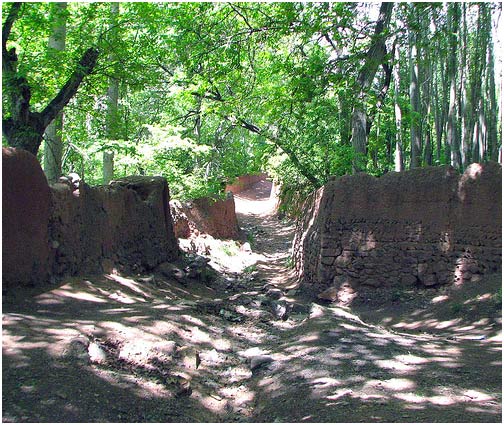
| Baghs in ancient Abyaneh, near Kashan in Isfahan Province, Iran An urban forest |
Zoroastrians have a reputation for creating lush gardens or baghs (also see our Overview page's section on Lush Gardens - Paradise / Bagh - Pairidaeza). By one legend, Zarathushtra too is said to have tended and developed a paradise-like community garden from an otherwise barren landscape.
The word paradise comes from the Old Iranian word for exceptional gardens, pairi-daeza, which in later years was shortened to parideiza and then to paridiz. Pairi means all around, thoroughly and ultimate, while the precise meaning of daeza is uncertain. However, as a compound word, pairidaeza came to mean a celestial garden, a heavenly paradise on earth. The description of the Garden of Eden as paradise is derived from the Persian Avestan pairi-daeza, and some would say, was located in the northern Iranian Zagros mountains (see Gardens of Ancient Tabriz below).
Classical Hellenic writers called Persian gardens paradeisos / paradeisoi.
The Hanging Gardens of Babylon, described below, then one of the seven wonders of the world, were built based on the Median (western Iranian) gardens in the Zagros mountains.
The chahar-bagh gardens of the Taj Mahal (see photographs below) are a descendant of the formal chahar-bagh gardens at King Cyrus' palace in Pasargadae.
With the correct selection of trees, herbs and plants, the pairidaeza baghs were places that could include amongst the vegetation grown within, essential health giving plants of the haoma / barsom family.
When all the elements of the pairidaeza baghs are considered together, they form an integrated composition of shade, micro-climate, vegetation, refuge, and healing.
|
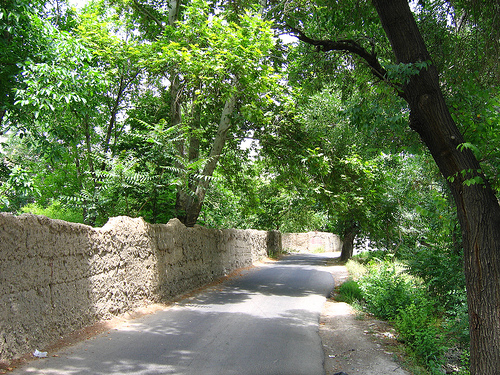
| Koocheh (Street) Bagh Tarasht, Tehran, Iran A street of walled baghs in Tehran |
To understand the true significance of the Persian gardens, the baghs, both informal and formal, it is necessary to put them in the context of the surrounding countryside of Iran and Central Asia - lands given to extremes in climate, from severe winters with blizzards, to burning summers with blinding dust storms. The mountains are for the main part barren and rocky, and the ever present deserts are covered with dust or a yellow slime where the water does not drain away. Within the desolation are verdant valleys and hidden forests. Elsewhere, the land can be dangerous and hostile to the unprepared visitor. The Aryans, however, saw an inner latent beauty - like that of a gem encased in rock. They left the countryside for the main part pristine, admiring it for what it was, as nature intended, and sacred as God's creation. Where land was required for human habitation, rather than scaring the earth, they helped make it blossom, a refuge not just for themselves, but for animals and rare plants as well. That was the ancient ethic.
Sadly, in the last thousand years, the thinking and situation in Iran has changed, a change that has accelerated in the past hundred years.
Capturing visions of the old Iran at the threshold of the modern age, Vita Sackville-West wrote in Passenger to Tehran (1926), "A savage, desolating country! But one that filled me with extraordinary elation. I have never seen anything that pleased me so well as these Persian uplands, with their enormous views, clear light, and rocky grandeur." He went on to say, "Persia has been left as it was before man's advent."
When the author of this web-page (Eduljee) lived in Tehran, Iran, he had the opportunity to visit some privately owned gardens or baghs located on the outskirts of the city. The gardens were walled compounds and a change in climate was evident immediately on entering through the garden's doors. Cool fragrant air welcomed the visitor. In summer, while the surrounding land was desert-like, barren and very hot, the baghs were lush with vegetation and cool. Water (often drawn from a well) played in significant role in the design and in the creation of the bagh's micro climate as well as its calming environment. They were oases with a spiritual quality. Places for restoration of spiritual, physical and community health.
Rejuvenation of the Spirit
The pairidaeza gardens are ideal places to rejuvenate the spirit. They are a meeting place for all elements of the spiritual and material creation. They are a place for personal reflection as well as strengthening family, friendship and community bonds. They are places, if a person so chooses, to reconnect with one's spiritual self and to take a hiatus from active life to continue a spiritual quest. Even the Achaemenian kings are reported to have personally and physically worked in building and taking care of their gardens (see below).
The pools or channels of water that are invariably an integral part of the garden's design, are places for self-reflection. The entire setting is tranquil and serene, a manifestation of the amesha spenta armaiti. Complimenting self-reflection is meditation, especially when accompanied with the recitation of a mantra (manthra). The very act of tending to the garden and nurturing the plants is a religious act.
The pairidaeza is a sacred space where an inner voice can be heard. They are places for sacred contemplation and spiritual nourishment.
|
In a garden, renew your Zoroastrian faith. Hafez |
Formal and Informal Gardens
The style or Persian gardens can be both formal and informal. The formal gardens are the type found in front of palaces, and are geometric in their layout. Cyrus' garden, the chahar bagh (see below, also spelt chahr bagh), meaning four gardens, consisted of four squares within a square - a quadripartite ground-plan. In addition to the various formal gardens in Iran, the gardens of the Taj Mahal in India are also an example of a formal garden. A example of informal gardens are the family baghs found on the outskirts of major Iranian cities such as Tehran.
Pasargadae's Chahar Bagh
 |
| Layout of the Pasargadae palace complex Gate A is the entrance building to the complex Palace S, situated just across the river is the apadana or audience hall The chahar bagh gardens are flanked by pavilions A and B Palace P is thought to be the private royal residence |
In Persian, chahar means four and bagh means garden. Chahar bagh or the four gardens was the formal garden style used by Cyrus the Great (c. 600 to 576 - August 530 BCE) for his palace gardens at Pasargadae, the capital of Pars (Persia) during his reign. The garden at Pasargadae is the earliest known example of the chahar bagh, a design that became the core design for subsequent formal Iranian gardens including the gardens of India's Mughal rulers. The gardens of the Taj Mahal in Agra, India are based on Cyrus' Chahar Bagh design and are so named even today (see photographs below).
There is some speculation in the literature, that the four quadrants of the garden - the four rectangles or squares within a rectangle or square - represented the four quadrants of the Persian empire. The squares were created by walkways and straight white limestone lined water channels that connected square basins or pools placed at regular intervals. These water-courses or aqueducts formed the principle and secondary axes of the quadripartite layout and are the earliest known record of gravity-fed water rills cascading into regularly spaced basins arranged in a geometric system. The channels and basins served both a practical irrigation function and an aesthetic function. Besides, they also modified the climate of the immediate surroundings.
There were two pavilions beside the garden, where the royal family or visitors could sit and enjoy the beauty and fragrant air. Cyrus also had a throne placed at the midpoint of the southwest portico of palace P (see the diagram above) from where he could view and contemplate the gardens and possible even hold an audience.
It is this writer's feeling, that in addition to the formal gardens, there would also have been a surrounding park-like forest that included animals.
According to Penelope Hobhouse, Erica Hunningher, and Jerry Harpur in their book Gardens of Persia, the chahar-bagh gardens of Pasargadae could have contained fruit trees such as pomegranate and cherries, nut bearing trees such as almond, vines and roses, an under carpet of clover interspersed with spring-flowering bulbs such as iris and tulips, as well as poppies. The surrounding trees would have provided wind breaks, trees such as white-stemmed poplars, cypress and plane (chenar).
Description of Achaemenian Gardens
The gardens of the Persian monarchs and their satraps (governor-generals) became legendary. Hellenic authors such as Quintus Curtius (7.2.22), Xenophon (Oec. 4.20-25) and Plutarch (Alc. 24.7) give consistent accounts of the satrapical paradise gardens, the paradeisos / paradeisoi (from pairidaeza).
Plutarch describes the paradeisos of the Achaemenian satrap at Sardis as follows: "One of them was the handsomest because its lawns and refreshing waters, its retreats and its manicured lawns displayed and unimaginable royal luxury."
Xenophon describes the paradise-gardens at Celaenae (Anab.1.2.7) and Dascylium (Hell. 4.1.15-16). In Celaenae, Xenophon and his companions saw "a great park filled with wild animals... and watered by the Meander. Xenophon notes that in Dascylium, "That is where Pharnabazus maintained his residence, with handsome large villages all around, abundantly provided with all the resources, and with game both in enclosed paradises and in open spaces - magnificent game! Through the whole length flowed a river stocked with every kind of fish. Wildfowl were there in abundance as well, for those who might hunt for birds."
Achaemenian Kings as Gardeners
 |
| Miniature 15 century painting of a Persian bagh |
The Achaemenian kings took a personal interest in gardening. The Spartan General Lysander, who joined a later Achaemenian Persian king Cyrus the Younger as a mercenary in 401 BCE, reported to Xenophon how the Persian kings excelled not only in war but also in gardening, creating paradeisoi (from pairidaeza) where they collected plants and especially fruit bearing trees and animals encountered during their foreign expeditions. Xenophon transcribed the Persian pairidaeza to his Greek form of paradeisos, the term that would later be used for the Garden of Eden in the Greek translations of the Christian Bible.
Xenophon went on to write, in his Oeconomicus (Economics 399 BCE)" The Great King...in all the districts he resides and visits...takes great care that there are 'paradises' as they call them, full of all the beautiful things the soil will produce."
First described in Xenophon's Oeconomicus, the garden of Cyrus the Younger (not to be confused with Cyrus the Great), son of Darius II (r. 423-404 BCE) and brother of Artaxerxes II (r. 404-359) were translated and reproduced in Cicero's philosophical treatise, On Old Age, the opening lines of which read: "... to prove to you that he thought nothing so worthy of royalty as an interest in farming - he has Socrates telling Critobulus a story about Cyrus the Younger, King of the Persians, a man of out-standing intellectual qualities and a truly great ruler. It seems that Lysander of Sparta, himself a man of no mean endowments, had come to Sardis to visit Cyrus ... [who] took him to see a piece of land, fenced in and meticulously planted. Lysander expressed amazement at the height of the trees and at their neatly staggered rows...."
Here, we pick up Xenophon's original account at Oeconomicus/Economist 4: "Lysander, it seems, had gone with presents sent by the Allies to Cyrus, who entertained him, and amongst other marks of courtesy showed him his 'paradise' at Sardis. Lysander was astonished at the beauty of the trees within, all planted at equal intervals, the long straight rows of waving branches, the perfect regularity, the rectangular symmetry of the whole, and the many sweet scents which hung about them as they paced the park. In admiration he exclaimed to Cyrus: "All this beauty is marvellous enough, but what astonishes me still more is the talent of the artificer who mapped out and arranged for you the several parts of this fair scene." Cyrus was pleased by the remark, and said: "Know then, Lysander, it is I who measured and arranged it all. Some of the trees," he added, "I planted with my own hands." Then Lysander, regarding earnestly the speaker, when he saw the beauty of his apparel and perceived its fragrance, the splendour also of the necklaces and armlets, and other ornaments which he wore, exclaimed: "What say you, Cyrus? did you with your own hands plant some of these trees?" whereat the other: "Does that surprise you, Lysander? I swear to you by Mithres, when in ordinary health I never dream of sitting down to supper without first practising some exercise of war or husbandry in the sweat of my brow, or venturing some strife of honour, as suits my mood." "On hearing this," said Lysander to his friend, "I could not help seizing him by the hand and exclaiming, 'Cyrus, you have indeed good right to be a happy man, since you are happy in being a good man.'"."
Oeconomicus/Economist 5: "All this I relate to you (continued Socrates) to show you that quite high and mighty people find it hard to hold aloof from agriculture, devotion to which art would seem to be thrice blest, combining as it does a certain sense of luxury with the satisfaction of an improved estate, and such a training of physical energies as shall fit a man to play a free man's part. Earth, in the first place, freely offers to those that labour all things necessary to the life of man; and, as if that were not enough, makes further contribution of a thousand luxuries. It is she who supplies with sweetest scent and fairest show all things wherewith to adorn the altars and statues of the gods, or deck man's person. It is to her we owe our many delicacies of flesh or fowl or vegetable growth; since with the tillage of the soil is closely linked the art of breeding sheep and cattle, whereby we mortals may offer sacrifices well pleasing to the gods, and satisfy our personal needs withal."
Earlier in 4.17, "'Cyrus therefore, Socrates' said Critobulus, '...prided himself no less in keeping his province fertile than he did in keeping it in order and on his ability in war.'"
Epicurean & Zoroastrian Garden Concepts
 |
| Artist's concept of Epicurus' Athenian Garden, closed by the Christian Emperor Justinian in 529 CE and was re-established in 2005 CE. Note in the background, the agora, the Persian-based public free-square cf. Xenophon's Cyropaedia. Image credit: Artist Candace Smith at Politics 213 |
As is the wont of classical Hellenic writers and philosophers of the Achaemenid-Parthian period, Persian ideas and concepts soon become obfuscated in their hands and the subject of much argument. It appears that philosopher Epicurus (341-270 BCE) thought of his school as a garden both figuratively and metaphorically. Some of the objectives of his philosophy coincide with Zoroastrian ideals. It is the manner in they are framed that makes some ideas untenable and the subject of debate, even derision.
The goal of philosophy and life in Epicureanism is the attainment ataraxia, peace and freedom from fear, and aponia, the absence of pain, and by living a self-sufficient life surrounded by friends. The concept is fairly close to the Zoroastrian goal in life: armaiti and ushta - abiding happiness, peace & serenity. The pursuit of pleasure and a painless existence and a number of justifications for the philosophy is where Zoroastrianism and Epicureanism part company. Zoroastrianism does not see removal of oneself from the rigours of life as an option. An inscription on the gate to Epicurus' garden is recorded by Seneca in epistle XXI of Epistulae morales ad Lucilium. In the reference, the inscription is purported to state, "Stranger, here you will do well to tarry; here our highest good is pleasure." Epicurus is also reported to have developed a personality cult focused on him as saviour.
In the Epicurean version of the garden of philosophical discussion, the garden signifies a philosophical retreat from the political sphere. The concept soon drew attacks. According to Robert Baldwin, Associate Professor of Art History at Connecticut College, the Epicurean gardens were attacked as slothful, luxurious and effeminate by Platonists, Aristotelians, and later Stoics who made political engagement the culmination of all philosophical life. Further, "not surprisingly, the garden could also represent a contemporary moral decline into slothful 'Epicurean' luxury, lasciviousness, and a self-deceiving, politically destructive retreat from civic responsibilities, as in Columella, Pliny, Plutarch, and Tacitus." We see here the Hellenistic propensity to swing between extremes.
The Zoroastrian approach is a balance between the competing demands and functions of life. The need to develop a calm environment to enable a person to refocus is not an end in itself - only a means to enabling the ability to lead an active, productive and useful life. Both pursuits have a time and a place in the life of a person. A paradise-like garden is seen as a place for spiritual and mental rejuvenation. As we have noted above, it is also a place for individual introspection, but by one legend, it might very well have been in Zarathushtra's time, also a place for calm dialogue and a philosophical discussion (see the Legend of the Grain of Wisdom). But a paradise-garden is not the only means of creating an environment where one can achieve armaiti, serenity. Nature has provided us with her own profusion of gardens from the desert oasis, to verdant meadows, to picturesque valleys and mountain slopes with breath-taking vistas. For Persian kings, their paradise-baghs gave them an opportunity to bring the bounty of nature into their backyard and one they could stroll through or sit and gaze upon in close proximity to home and work.
There is much about the principles behind an Epicurean garden that would find congruence in the principles behind a Zoroastrian community garden. Both are egalitarian and welcomed everyone who wished to enter. Epicurus emphasized friendship as an important ingredient of happiness and that coincides with the Zoroastrian-Mithraic concept of building friendship based on trust, kindness and caring.
Other variations of the more serious, sober Epicurean garden of reason and philosophical discussion - and those that find parallels with variations in Persian gardens are the herbal and medicinal gardens described at length by Pliny and Columella. Robert Baldwin states, "the most important philosophical gardens were those which Xenophon and Cicero rescued from Epicurean leisure. They did this by making the garden into the personal arena of the wise, philosopher-king, Cyrus of Persia. His philosophical discussions made gardening compatible both with higher political obligations and a severe morality controlling all bodily appetites and passions. To further cleanse the garden of any Epicurean taint, Cicero inserted Xenophon's garden of Cyrus into his own meditation on nature as a final, philosophical retreat after a lifetime of public service."
|


Gardens of Ancient Tabriz
 |
| Map of Gan Eden location proposed by David Rohl Click to see a larger image. Map photo credit: Wikipedia |
In 1999, reports were published on the discovery of ruins of an ancient garden found about sixteen kilometres (ten miles) from the northwest Iranian city of Tabriz (see map). Tabriz, in turn, is about 70 km. (40 mi.) east of Lake Urmia, a lake that features prominently in early Persian and Median history.
British archaeologist David Rohl from University College, London, was quoted in the The Jerusalem Report (February 1, 1999) in an article titled Paradise Found, as saying, "As you descend a narrow mountain path, you see a beautiful alpine valley, just like the Bible describes it, with terraced orchards on its slopes, crowded with every kind of fruit-laden tree."
"The Biblical word gan (as in Gan Eden) means 'walled garden,'" Rohl continues, "and the valley is indeed walled in by towering mountains." The highest of these is Mt. Sahand, a snow-capped extinct volcano that Rohl identifies as the Prophet Ezekiel's Mountain of God, where the Lord resides among `red-hot coals' (Ezekiel 28:11-19). He continues by saying that cascading down the once-fiery mountain, precisely echoing Ezekiel, is a small river, the Adji Chai* (also spelt Adji Chay and Aji Chai the name of which also translates in local dialect as 'walled garden'. Enclosing walls are a feature of Persian gardens). The locals still hold Sahand mountain as sacred, says Rohl, and attribute magical powers to the river's water.
Our note: Rohl's translation of Adji Chay may not be correct. Adji Chai is a Turkish name meaning bitter river referring to the high salt content of the river's waters. The ash deposited after a volcanic eruption by Mount Sahand could very well have provided the nutrients to sustain lush vegetation.
Rohl's Gan Eden extends from Lake Urmia east towards the Caspian Sea to what he considers was the land of Nod. On its southern boundary lies the ancient city of Kandovan, whose houses are carved into conical lava pillars.
We are not concerned here about the veracity of Rohl's claims. Rather, what is significant is the possibility that the reputation of ancient Persian gardens may have inspired the concept of the biblical garden of Eden.
(* The Adji Chai is also called the Talkheh Rud, (rud meaning river) and is formed by merging of three smaller rivers of Ab Nahand, Quri / Guri Chai, and Ojan Chai which all originate from the Sabalan Mountain range, southeast of Tabriz. The Adji / Aji Chai discharges in Lake Urmia / Orumieh after passing through the valleys between the Sorkhband and Yekkeh Chin mountain north of Tabriz and Osku districts. A tributary, the Mehran Rud also called Liqvan Rud, originates from the peaks between Karim and Sultan Mountains overlooking the Liqvan village near Esparakhoon and Qeshloq villages and joins the Adji / Aji Chai in Tabriz.)
|

Hanging Garden's of Babylon
|
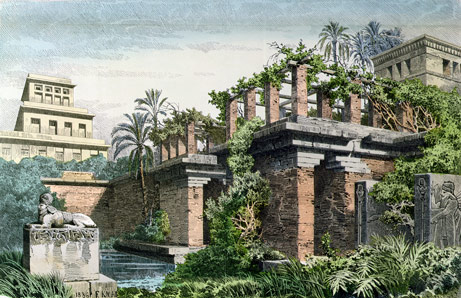
| Hanging Gardens of Babylon. An artist's impression |
The Hanging Gardens of Babylon (also called the Hanging Gardens of Semiramis), were one of the seven wonders of the world according to Greek writers Alexander Polyhistor quoting Berossus (c. late 4th - 3rd century BC ?). The Hanging Gardens were an example of an urban patio, balcony and roof-top garden.
They were reputed to have been built by King Nebuchadnezzar (605-562 BCE) around 600 BCE to placate his Median wife, Amytis, daughter of Cyaxares, the King of the Medes. Nebuchadnezzar made for Amytis, a vast terraced garden full of trees and exotic plants of every description with cool glades, fountains, and bubbling streams. By copying the lush gardens from her childhood home on the slopes of the Zagros mountains, he hoped that she would not miss her Iranian homeland and think of the palace as home.
The palace and its gardens are thought to have been located near present-day Al Hillah (formerly Babylon) in Iraq.
In ancient writings the Hanging Gardens of Babylon were first described by Berossus (c. late 4th - 3rd century BCE), a Chaldean priest. His account were quoted by later Greek authors such as Alexander Polyhistor (c. 1st century BCE), Strabo and Diodorus Siculus (see below).
Strabo (63/64 BCE - ca. AD 24), Geographies, Book 16, ch 1, § 5:
"...the hanging garden are called one of the Seven Wonders of the World. The garden is quadrangular in shape, and each side is four plethra (one plethron equals 100 feet) in length. It consists of arched vaults, which are situated, one after another, on checkered, cube-like foundations. The checkered foundations, which are hollowed out, are covered so deep with earth that they admit of the largest of trees, having been constructed of baked brick and asphalt — the foundations themselves and the vaults and the arches. The ascent to the uppermost terrace-roofs is made by a stairway; and alongside these stairs there were screws, through which the water was continually conducted up into the garden from the Euphrates by those appointed for this purpose. For the river, a stadium in width, flows through the middle of the city; and the garden is on the bank of the river."
Diodorus: (C. 1st cent. BCE)
"Vaults had been constructed under the ascending terraces which carried the entire weight of the planted garden; the uppermost vault, which was seventy-five feet high, was the highest part of the garden, which, at this point, was on the same level as the city walls. The roofs of the vaults which supported the garden were constructed of stone beams some sixteen feet long, and over these were laid first a layer of reeds set in thick tar, then two courses of baked brick bonded by cement, and finally a covering of lead to prevent the moisture in the soil penetrating the roof. On top of this roof enough topsoil was heaped to allow the biggest trees to take root. The earth was levelled off and thickly planted with every kind of tree. And since the galleries projected one beyond the other, where they were sunlit, they contained conduits for the water which was raised by pumps in great abundance from the river, though no one outside could see it being done." 2. Wellard, 1972, pp. 156
• © Author: K. E. Eduljee, Zoroastrian Heritage, 2005-23 (researched from 1979 onwards) • Contact • Page validated by W3C.org