Contents
Turkmenistan Region
| Mouru - GonurTurkmenistan Region Page 3
Turkmenistan Region Pages:
 | Murgab delta and oasis (circled) in the south of Turkmenistan The Murgab river spreads out and disappears into the Kara Kum desert to the north |
Mouru & Murgab River DeltaMouru or Mourum, the third Vendidad nation, is generally thought to have included the Murgab river delta and the region around Merv, now a part of southern Turkmenistan. Ruins of over 150 ancient settlements dating back to the early Bronze Age (2500-1700 BCE) have been found in the the delta region covering an area of more than 3000 sq. km. and which consisted of 78 oasis. There are reports that the earliest agricultural settlements may date as far date as the 7th millennium BCE.
The earlier 3rd millennium BCE settlements (Kelleli, Adji Kui, Taip, Gonur, and Togolok / Togoluk) are found to the north of the oasis, where in ancient times, the Murghab river came to the surface (see image to the right). It appears that the development of more advanced irrigation techniques in the early Iron Age, enabled the start of settlements south towards the ancient city of Merv which appears to have been an Achaemenian era (519-331 BCE) administrative centre or capital of the country which the Achaemenians called Margush.
The Region & ZoroastrianismIn trying to understand if the region was home to Zoroastrians, it is important to bear in mind that Zoroastrians have seldom lived in exclusively Zoroastrian communities. In listing the nations after Airyana Vaeja, the Vendidad cites non-Zoroastrian traits in many of the nations, indicating that that the Aryan Zoroastrians lived in multi-cultural communities - communities that were not exclusively Zoroastrian or Aryan. In addition, because ancient Zoroastrians did not worship in temples, because they did not bury their dead, and because they were careful about defiling the environment with garbage, they left scant evidence of their presence.
What we learn from the archaeological findings under the tepe or depes in the Murgab region supports the history contained in the Avesta, a history we have outlined in our pages on the Aryans.
Tepe or DepeTepe or depe is a Turkoman word for a mound and is synonymous with the word tell used in the Middle East to denote mounds or hills. In treeless areas, such geographic features often indicate ancient settlements formed from mud-brick structures that later human occupation have compressed over time into artificial hills sometime consisting of the different layers of later construction, each with a different dating. The lower layers are therefore normally the older layers.
The largest of the settlements uncovered is Gonur-Tepe.
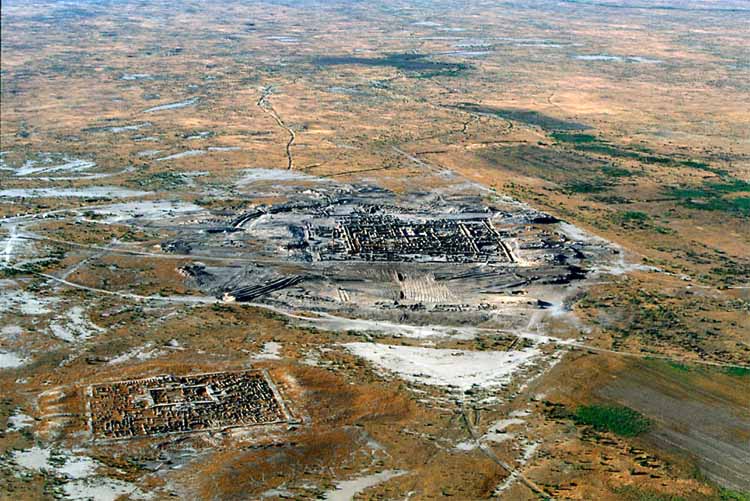
 | | Gonur-Tepe & surrounding tepe settlements |
GonurThe Archaeological SiteThe largest of all the ancient settlements uncovered in the Murgab delta is Gonur-Depe or Gonur-Tepe. Gonur is located seventy kilometres north of the ruins of Merv and a three-hour drive from Mary in an area that is now sparsely populated.
The Gonur site occupies an area of about 55 hectares and consists of the main settlement in the northern section of the site and a smaller (130 x 120 m) area south of the main settlement.
In the centre of the northern section is a fortified area containing a palace-like complex.
The smaller three hectare southern section consists of a wide 8-10m high walled 'fortress' with round towers at its corners similar to the structure in the aerial photograph to the left. The walls enclosed residences and possibly a temple.
Reference: Excavations at Southern Gonur, by V. Sarianidi, 1993, British Institute of Persian Studies. » Brief History of Researches in Margiana at Museo-on.com » Temples of Bronze Age Margiana: traditions of ritual architecture by Viktor Sarianidi
Photo sites: » Flickr » Uncornered Market.
Description of Ancient GonurGonur was a large town for the times and home to thousands of residents. The town had carefully designed streets, drains, temples and homes. The surrounding fields and orchards were watered using lengthy canals that the residents had dug from glacier-fed rivers. Since the rivers were fed by glaciers and since the framers did not have to rely on rain for irrigation, their crops were not threatened by drought. the people grew a wide variety of crops, including wheat, barley, lentils, grapes, and fleshy fruits.
The people of Gonur were also traders and developed the first trade links between the East and the West along what came to be known as the silk roads and traded with distant cities for ivory, gold, and silver. They buried their dead in elaborate graves filled with fine jewellery, wheeled carts, and animal sacrifices. The site provided archaeological evidence from only a few centuries, leaving historians to wonder if the society flourished for just a few hundred years, after which the residents abandoned the town.
Gonur had a central citadel surrounded by a high wall and towers 100m by 180m (nearly 350 by 600 feet) in size, set within another vast wall with square bastions, which in turn is surrounded by an oval wall enclosing large water basins and many buildings.
Viktor Sarianidi (see below) began a trend to call Gonur, Margush or the capital of Margush, a name used by the Achaemenians for Mouru or Merv.
Water ManagementIn addition to the water canals the residents of Gonur had dug from the river to water their fields, the city also had a sophisticated water supply and sewage system.
Water was brought in to the city using underground ceramic pipes with socket (male/female) joints that would have required sophisticated manufacturing and fitting techniques. In the photograph to the right, we see an uncovered pipe for bringing water into a palace-like building.
The city also appears that two separate sewage systems, one for ordinary waste water and the other - it is suggested - for water that had been used for the ritual washing of bodies during funerals.
TempleA web article posted by State News Agency of Turkmenistan and quoting Viktor Sarianidi (see below) leader of the excavations, states that in the spring of 2006, his team uncovered a large temple building near the central palace, dated from the late 3rd to the early 2nd millennium BCE.
Other web articles include Discover Magazine, Anahita Gallery, Kar Po's Travel Blog, Dan & Mary's Monastery, Archaeology Online, Turkmenistan June 2006 and Stantours. Generally, we find the quality of research and reports available of the web to be less than adequate - poorly researched, highly speculative and sensationalistic.
In reading the articles, we should keep in mind that the early Bronze Age Zoroastrians did not construct temples. This does not mean that the residents of the town did not include Zoroastrians, for it is quite conceivable that Zoroastrians and non-Zoroastrians lived side-by-side.
 | Temple(?) building walls uncovered in Gonur-Depe with three narrow rooms to the left Photo credit: Country Turkmenistan |
State News Agency of Turkmenistan article describes the building uncovered in 2006 as "a monumental building remarkable for the strict geometrical forms and brilliant architectural design. The central part of the shrine which has the walls sometimes 1.5 meters thick and strictly oriented to the sides of horizon is of particular interest. The rooms have the complementary angles. The principles of planning some architectural blocks indicate the specific purposes of using the temple complex. E.g., three single-type corridor-like rooms directly correspond to the architectural design of monumental constructions in the ancient Orient."
The larger room has a circular foundation (see photograph above) which the article describes as a furnace with an inner and outer chamber. The inner chamber contained burnt material presumably residue of the fuel used but which the article does not identify.
Pots found in the vicinity had an internal lining that made them waterproof, thereby capable of holding liquids.
Speculation About the Use of HaomaThe report further states that the archaeologists found evidence that the haoma-like ritual was performed in the building. However, this report is disputed by scientists (Hiebert 1994: 123-129; Parpola 1998: 127;) using more credible analysis techniques (at laboratory of the Helsinki University). Sensationalistic claims by Viktor Sarianidi (see below) of the discover of narcotic material and completely unsubstantiated links with the haoma ritual were found after a more careful study to be implausible.
According to James P. Mallory 1989 & 1997 "... remains of ephedras have also been reported from the temple-fortress complex of Togolok 21 in the Merv oasis (ancient Margiana – Parpola 1988; Meier-Melikyan 1990) along with the remains of poppies. ... In 1990 I received some samples from the site [forwarded by Dr. Fred Hiebert of Harvard University], which were subjected to pollen analysis at the Department of Botany, University of Helsinki. .... The largest amount of pollen was found in the bone tube (used for imbibing liquid?) from Gonur 1, but even in this sample, which had been preserved in a comparatively sheltered position when compared with the other investigated samples, only pollen of the family Caryophyllaceae was present. No pollen from ephedras or poppies was found and even the pollen left in the samples showed clear traces of deterioration (typical in ancient pollen having been preserved in a dry environment in contact with oxygen). Our pollen analysis was carefully checked for any methodological errors, but no inaccuracies were found."
When the careful analysis of the residues in pots did not support Sarianidi claims of the discovery of narcotic substances, the excuse offered is that the vessels are now exposed to the sun and the evidence has been destroyed. Unfortunately, this excuse uncovers yet another problem with Sarianidi excavations - careless exposure of the artefacts and the ruins. Based on this unverifiable claim and quotes from Turkmenistan's late President-for-life's personality cult writings, Sarianidi also makes the unsubstantiated claim that Gonur is the birth place of Zoroastrianism. While Zoroastrians could have lived in Gonur - if not elsewhere in the vicinity - there is no basis for this claim.
In any case, it is very doubtful if any temple complex can be associated with Zoroastrians as they did not worship in temples in those days. In addition, if the users of the temple engaged in a haoma-like ritual, the ritual was not the ritual practiced by Zoroastrians.
Archaeologists who know little about Zoroastrianism other than what they read in some fanciful books, should refrain from wild and sensational speculation that does a great deal of harm to Zoroastrians and Zoroastrianism. Their energies would be better directed at using best practices in digging up buried history that be destroyed by careless and disgraceful methods.
The speculation guised as an assertion regarding the preparation and use of haoma / hom in Gonur is bad enough. The association of haoma with a narcotic is pathetic.
Necropolis & Burial Customs | Pit grave in the necropolis Ceramic vessels & a bronze mirror lie next to the skull |
In one section of Gonur North, is a burial site, the necropolis, west of the palace site, containing mostly small children buried in pots. An article by Kate Fitz Gibbon of Anahita Gallery states:
"Their tiny, newborn bones are so fragile that they crumble at a touch. The beautiful Bronze Age beads from plundered sites in Afghanistan have long fascinated me. Most often, buried bead materials are found in vessels placed close to the body, and as any stringing material has long since disintegrated with age, it is not even possible to guess how they were worn. In the Gonur Tepe palace, an unexpected find of a youth buried inside a large ceramic vessel included not only rich grave goods, but also clues as to how some beads were worn. Skull and neck vertebrae were held together with hardened mud, and as the dirt was removed, lapis, talc and a single, inch and a half long carnelian bead carved in chevron patterns were found encircling the neck. A single gold earring was embedded near the ear, and a half-dozen large, finely polished banded agate beads lay in the bottom of the vessel in which the youth was buried.
"My mother and I spent most of our days at Gonur in the large necropolis to the west of the palace site. We used fine brushes to remove the last of the dirt from the whitened bones and grave goods uncovered by the diggers. Each day, three or four grave pits were uncovered and cleared of dirt to the undisturbed earth - about four feet below the present surface. After each day's excavations at the necropolis, the pits were photographed and partially filled in again. Most skeletons appeared still to lie as they were buried; knees and elbows flexed, the head often resting on or near a small pile of ceramic and stone vessels. It was clear, however, that the necropolis had been robbed in antiquity. Very few items of jewellery were found, and in one grave, a fine, carved alabaster cylinder seal was unearthed under just a few inches of surface soil. A too hasty grave plunderer had apparently dropped it, several thousand years before."
Gonur ArtefactsThe quality, artistry and workmanship of the artefacts unearthed at Gonur has surprised observers. They include intricate jewellery incorporating gold, silver, lapis lazuli, and carnelian. The prowess of the Gonur metalworkers - who used tin alloys and delicate combinations of gold and silver - were on par with the skills of their more famous contemporaries in Egypt, Mesopotamia, and the Indus Valley. Their creations display a rich repertoire of geometric designs, mythic monsters, and other creatures. Among them are striking humanoid statues with small heads and wide skirts, as well as horses, lions, snakes, and scorpions.
Wares in this distinctive style had long been found in regions far and near. As close as Gonur's southern neighbour Balkh in today's Afghanistan, and as far as Mesopotamia to the west, the shores of the Persian Gulf to the south, the Russian steppes to the north, and to the southeast across the Hindu Kush - the great cities of Harappa and Mohenjo Daro, which once flourished on the banks of the Indus River in today's Pakistan. Archaeologists had puzzled over their origin. The Gonur excavations seem to solve the puzzle. These items in the distant lands originated in the region around Gonur and were actively traded by the merchants of Gonur and Central Asia, possible originators of the Silk Roads.
The Abandonment of GonurThe archaeological record found in Gonur's ruins lasts for a few hundred years. Archaeologists have not found later artefacts or later layers covering the Bronze Age layer. This has led researchers to surmise that Gonur was abandoned either for reasons of warfare or because of the receding waters of the Murgab, compelling resident to move towards Merv and the surrounding foothills.
In the Avesta's Vendidad, the virtues associated with the people of Mouru are that they were brave and holy. The evils associated with Mouru are plunder and bloodshed. We do not know if the Mouru engaged in bloodshed and plunder or if they were the victims of plundering aggressors.
The people and nations of the Avesta, the Aryans, were a settled, organized people who farmed and lived in towns. Zoroastrian texts tell us that it is from the north that an ill wind blew and that brought with it a violent and destructive people who raided and plundered the towns of the Aryans.
To the north of the central Asian Aryan kingdoms lay deserts and grazing land inhabited by nomads, a pastoral people who relied on herds that were constantly on the move seeking new pastures. The nomads also hunted for their food and raided the settlements of their neighbours.
There is evidence that extensive fires destroyed some of Gonur's central buildings - building that they were never rebuilt.
KelleliAs with Gonur, Kelleli is a Bronze Age (2500-1200 BCE) settlement located some 40 km northwest of Gonur. The settlement has two major sites: Kelleli 3 and 4. Kelleli 3 is four hectares in size and had double external wall with towers flanking four symmetrical entrances. In the south-western sector, is an area of houses. Kelleli 4 is three hectares in size and also has a double outer wall with towers. According to a UNESCO document, both sites are poorly preserved.
Toguluk / Togulok Togolok consists of two sites, Togolok 1 and Togoluk 21. Togoluk 21 is the larger of the two sites. According to Viktor Sarianidi:
"The next and last shrine excavated is located in the settlement of Togolok 21, which dates to the late 2nd millennium. Taking into account its large overall size (larger than the fortress of South Gonur), it is possible that the shrine of Togolok 21 served the inhabitants of the whole country of Margiana in the late Bronze Age. Similar to the above-described shrines, there is a domestic area near Togolok 21 associated with the shrine. At Gonur depe and Togolok 1 the settlements are many times larger than the shrines, while in Togolok 21 the settlement is a great deal smaller than the shrine itself.
"The shrine of Togolok 21 was built at the top of a small natural hill. Along the outer face of the exterior wall are circular and semicircular hollow towers. In the northern part of the wall are two pylons between which a central gateway, supposed to be the entrance to the shrine, is located. The second entrance was built in the middle of the southern wall. The whole inner area was not built up except at the western side where some extremely narrow rooms are located which appear to have had arched ceilings. Their purpose is unclear. Two altar sites located opposite each other in the northern part of the shrine were perhaps used for carrying out ritual ceremonies associated with libations and fire rituals."
Adji KuiAnother Bronze Age (2500-1200 BCE) settlement Adji Kui is located about 13 km northwest of Gonur. The present site, Adji Kui 8, is about 8.5 hectares in size.
TaipThe ruins of Taip indicate that the settlement typifies the transition from a Middle Bronze Age form of settlement pattern to a Late Bronze Age settlement. Two close but distinct mounds consist of a 3.5 hectare walled square area with a large courtyard building in the south.
Very Poor Archaeological Practices | Thousands of pottery shards are scattered across the Gonur-depe excavation site. Visitors steps over these priceless artefacts further destroying a priceless treasure. Photo credit: Eurasianet.org |
The discovery of the ruins in the Merv region may be a mixed blessing. One the one hand the world has become aware of another centre of civilization. On the other hand, the very poor archaeological practices may be the cause of the speedy destruction of the evidence. The following is a quote from Eurasianet.org's article Turkmenistan: Making a Bid for Cradle-Of-Civilization Status
"In a painful irony, some of the dust that swirls around Gonur-depe comes from the crumbling walls themselves. To study the city, Sarianidi's team had to remove the protective earthen shield laid down over millennia, thereby exposing the structures beneath to the desert sun and wind. Indeed, today’s photographs of Gonur-depe show a significant deterioration when compared to those of the 1970s and 1980s."
"Without a greater commitment from the Turkmen state, funding will dry up, the guide said, and Gonur-depe will slowly blow away."
Research Sites: » Brief History of Researches in Margiana by Museo-on
Viktor Sarianidi | | Viktor Sarianidi |
For over 30 years, Turkmenistan's Professor Viktor Sarianidi, Laureate of the Magtymguly International Prize and Doctor of History, has headed the Margiana Archaeological Expedition that has conducted excavations in Turkmenistan and other Central Asian states.
The sites include Namazga-Depe, Altyn-Depe, Delbarjin, the Dashly Oasis, Toholok 21, Gonur, Kelleli, Sapelli, and Djarkutan. In Gonur-Depe for instance, where others saw only sand and scrub, Sarianidi saw the remnants of a wealthy town protected by high walls and battlements. (Indeed all the sites have high protective walls.)
 | | Ancient pottery carelessly strewn all over Sarianidi supervised sites |
While some researchers have applauded Sarianidi for his dedication, others view him as an eccentric, employing brutish and old-fashioned techniques. These days Western archaeologists typically unearth sites with dental instruments and mesh screens, meticulously sifting soil for traces of pollen, seeds, and ceramics. Sarianidi uses bulldozers to expose old foundations, largely ignores botanical finds, and publishes few details on layers, ceramics, and other mainstays of modern archaeology. Ceramics that he has unearthed and which for millennia have remained protected deep in the sand now lie strewn about his sites with visitors stepping over them as they walk around. Local residents and animals also climb all over the fragile earthen structures. His reports are also sensationalistic, conjectural and poorly researched. Sarianidi's conclusions are routinely contradicted by a more sober analysis. Nevertheless, his findings have provided rich fodder for those captivated by the fantasy generated by his claims. It is unfortunate that his lack of credibility by serious scholars may obscure his other accomplishments. A further tragedy that may overshadow his work is that paradoxically he may have a disservice in unearthing the ruins. The exposed ruins have been left with no protection and are being rapidly eroded.
As a Greek growing up in Tashkent, Uzbekistan, under Stalinist rule, Sarianidi was denied training in law and turned to history instead. Ultimately, it proved too full of groupthink for his taste, so he opted for archaeology. "It was more free because it was more ancient," he says. During the 1950s he drifted, spending seasons between digs unemployed. He refused to join the Communist Party, despite the ways it might have helped his career. Eventually, in 1959, his skill and tenacity earned him a coveted position at the Institute of Archaeology in Moscow, but it was years before he was allowed to direct a dig. In 1996, Sarianidi moved to Greece where he currently lives.
BMAC & Andronovo Archaeological Complexes | Bronze Age Indo-Iranian Archaeological Complexes Image credit: Wikipedia |
In 1976, Viktor Sarianidi proposed that the Bronze Age archaeological sites dating from c. 2200 to 1700 BCE and located in present day Turkmenistan, northern Afghanistan, southern Uzbekistan and western Tajikistan, were the remains of a connected Bronze Age civilization centered on the upper Amu Darya (Oxus). He named the complex the Bactria-Margiana Archaeological Complex (BMAC) and the inhabitants of that period and region, the Oxus civilization.
The name Andronovo complex comes from the village of Andronovo in Siberia where in 1914, several graves were discovered, with skeletons in crouched positions, buried with richly decorated pottery. The name has been used to refer to a set of similar Bronze Age cultures that flourished c. 2300–1000 BCE in western Siberia and the west Asiatic steppes of Kazakhstan. This culture is thought to have been a pastoral people who reared horses, cattle, sheep and goats.
The names of these groupings are those given by archaeologists and have no relation to historical names or one to another. They are better termed as archaeological complexes or archaeological horizons.
There are problems and inconsistencies using these archaeological complexes or archaeological horizons to construct history and anthropological (incorrectly called racial) or cultural connections. The archaeological horizons are the time period in which the groups are believed to have existed are based mainly on pottery and artefact similarities and datings. If no corresponding pottery or artefacts are found after a particular dating, the group is assumed to have disappeared or to have been displaced due to war, famine or disease.
Sarianidi is quoted (as cited in Bryant 2001:207) as saying that "direct archaeological data from Bactria and Margiana show without any shade of doubt that Andronovo tribes penetrated to a minimum extent into Bactria and Margianian oases".
The following are quotes from the University of Chicago's page on Archaeology and Language, The Indo-Iranians by C. C. Lamberg-Karlovsky:
"This review of recent archaeological work in Central Asia and Eurasia attempts to trace and date the movements of the Indo-Iranians—speakers of languages of the eastern branch of Proto-Indo-European that later split into the Iranian and Vedic families. Russian and Central Asian scholars working on the contemporary but very different Andronovo and Bactrian Margiana archaeological complexes of the 2d millennium BCE have identified both as Indo-Iranian, and particular sites so identified are being used for nationalist purposes. There is, however, no compelling archaeological evidence that they had a common ancestor or that either is Indo-Iranian. Ethnicity and language are not easily linked with an archaeological signature, and the identity of the Indo-Iranians remains elusive."
["C. C. Lamberg-Karlovsky is Stephen Philips Professor of Archaeology in the Department of Anthropology at Harvard University and Curator of Near Eastern Archaeology at Harvard's Peabody Museum (Cambridge, Mass. 02138, U.S.A.). Born in 1937, he was educated at Dartmouth College (B.A., 1959) and the University of Pennsylvania (M.A., 1964; Ph.D., 1965). His research interests concern the nature of the interaction between the Bronze Age civilizations of the Near East and their contemporary neighbors of the Iranian Plateau, the Indus Valley, the Arabian Peninsula, and Central Asia. His recent publications include Beyond the Tigris and Euphrates Bronze Age Civilizations (Tel Aviv: Ben Gurion University of the Negev Press, 1996) and (with Daniel Potts et al.) Excavations at Tepe Yahya, Iran: Third Millennium (American School of Prehistoric Research Bulletin 42)."]
It is regrettable that through conjecture alone, the Andronovo complex has been connected racially and culturally to the people of the BMAC complex. This error is compounded with the conjecture that the Andronovo complex is connected to the Aryans, misleading some to further believe that the Aryans originated in the Siberian steppes. Because some parts of the Andronovo complex are part of Russian Siberia, in an additional leap of faith, some people have translated the Andronovo region to mean the Russian steppes, leading some to state that the Aryans originated in the Russian steppes, a name that is usually associated with the western Russian steppes - west of the Caspian sea. One error leads to another. There is no credibility to the assertion that the Aryans originated in the Russian steppes.
Image site: » Flickr
» Top
» Page 1 - Turkmenistan Region Introduction » Page 2 - Nisaya & Anau » Page 4 - Mouru & Merv
|
|